

Everyday Napa Cabbage Kimchi
Everyday napa cabbage kimchi made with chopped cabbage, gochugaru, and a simple seasoning paste, then fermented naturally for clean, balanced flavor that works with daily Korean meals.
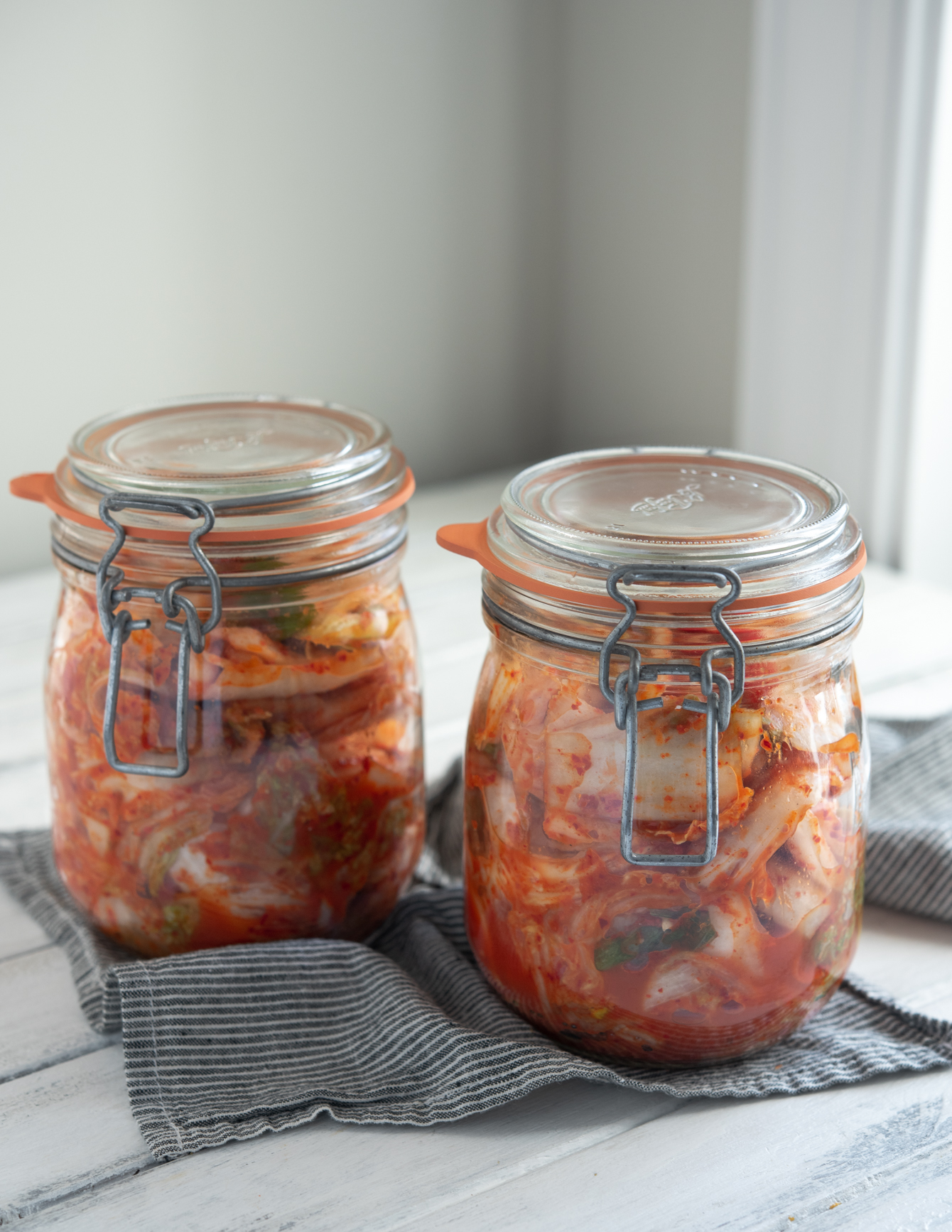
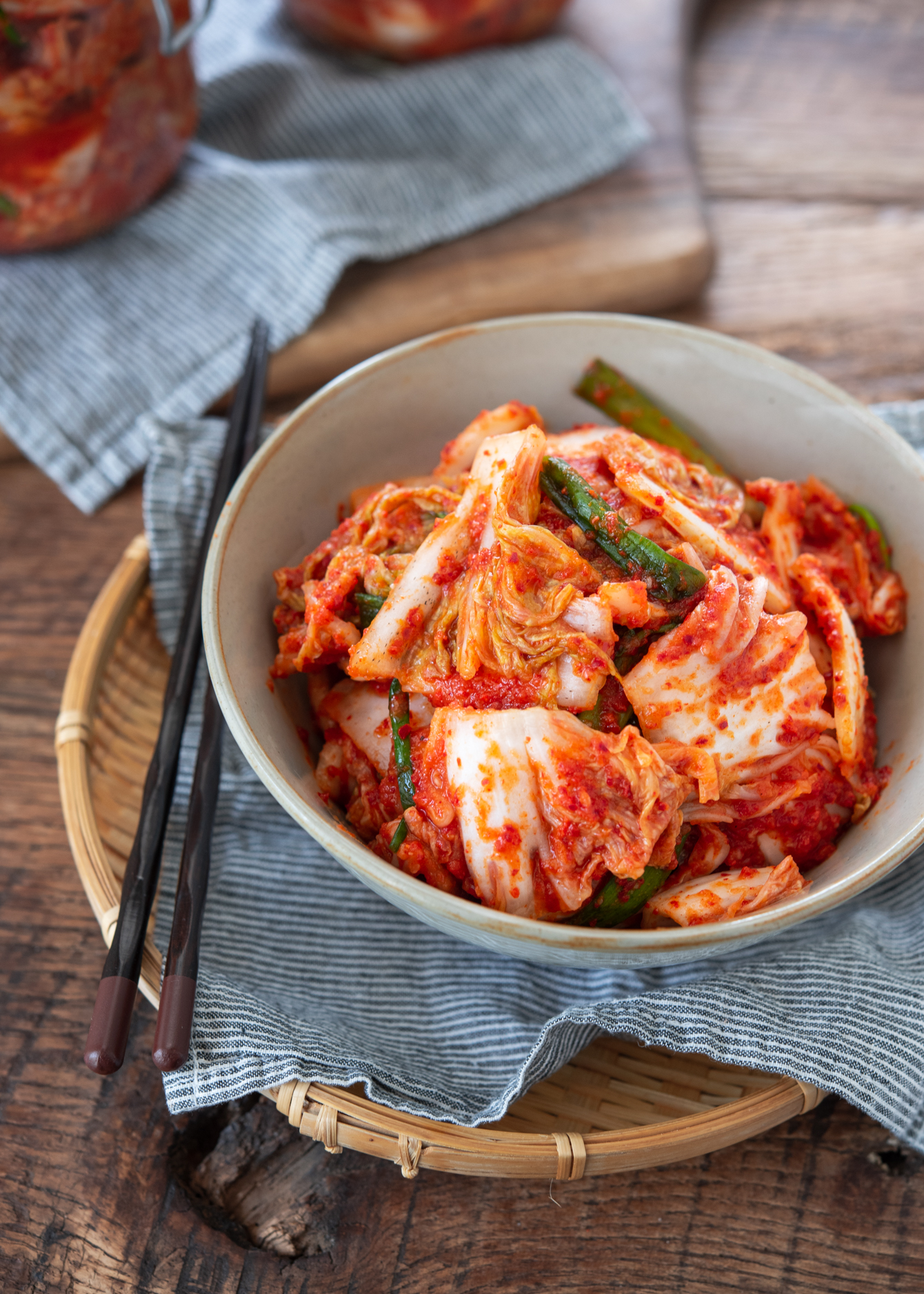
This is the napa cabbage kimchi I make most often at home — not for kimjang season, and not as a same-day salad, but for everyday meals. It’s a mak kimchi–style recipe, meaning the cabbage is chopped instead of left whole, which keeps the process practical while still allowing the kimchi to ferment properly and develop flavor over time.
I rely on this version when I want a dependable batch of kimchi in the fridge that gets better after a day or two, with balanced heat, tang, and savoriness. It’s the kind of kimchi that works with a simple bowl of rice, soups, or grilled dishes without overpowering the meal. If you’re looking for a home-style cabbage kimchi that’s straightforward, fermented, and made to be eaten daily, this is the recipe I come back to again and again.
Get new recipes via email:
Why This Is My Everyday Napa Cabbage Kimchi
This recipe is designed for regular home cooking, not large-batch kimjang or same-day kimchi. The cabbage is chopped for practicality, seasoned simply, and allowed to ferment so the flavor develops gradually in the fridge. I make this version when I want a reliable napa cabbage kimchi that works with everyday meals and improves over time.
For traditional, whole-cabbage kimchi made in larger batches, see my kimjang kimchi recipe, which follows the classic salting and fermentation process used for winter storage.
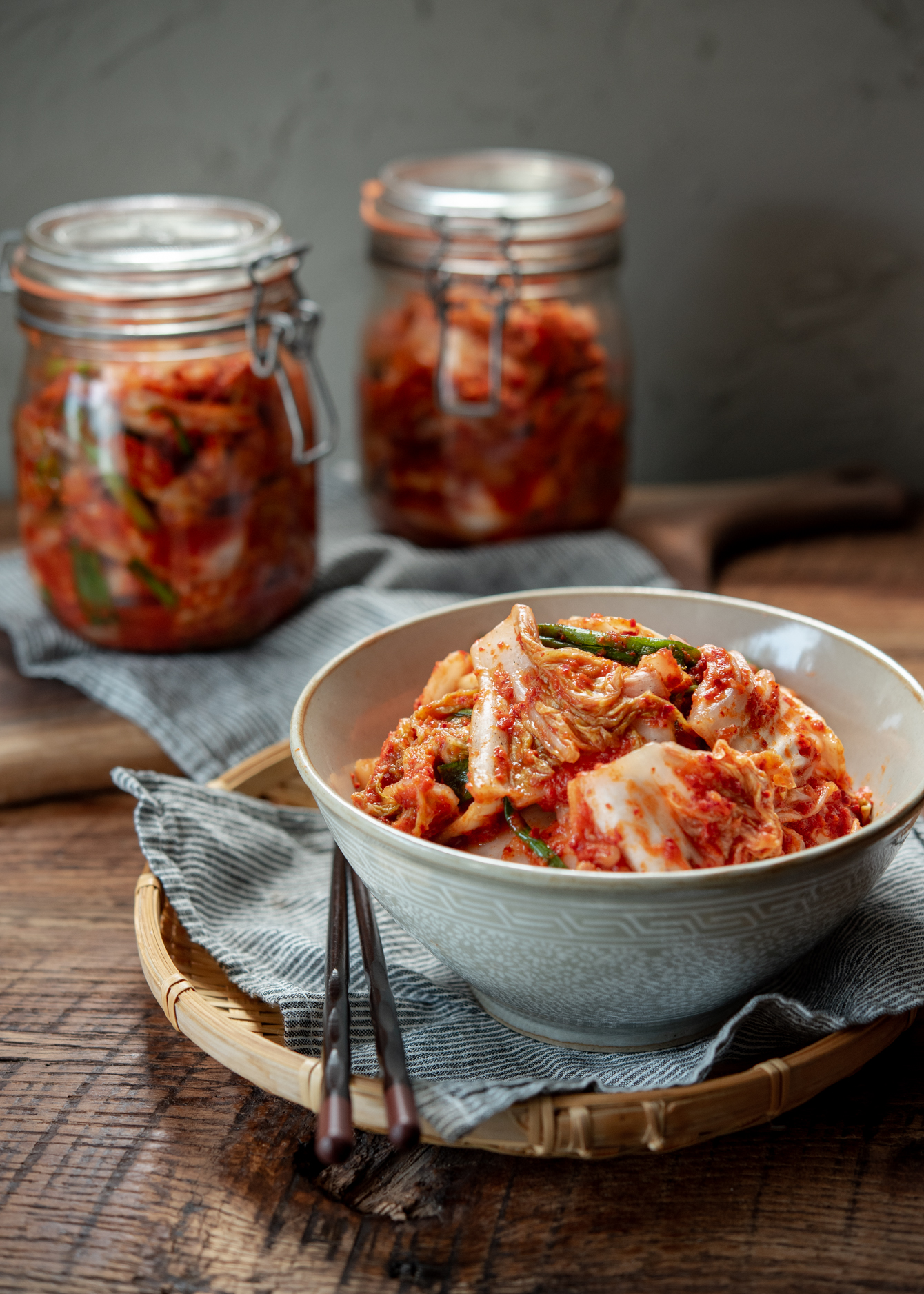
Key Ingredients for Cabbage Kimchi
After years of making kimchi both in Korea and abroad, I’ve found that choosing the right ingredients is key—especially for an everyday kimchi that’s meant to ferment and be eaten over time. Here are my go-to ingredients and why they matter.
Napa Cabbage: This is the classic base for kimchi, known for its crunchy texture that softens beautifully as it ferments. Can’t find napa? Green cabbage works in a pinch, though the texture and fermentation will be slightly different. I share a dedicated method in my green cabbage kimchi recipe.
Korean Coarse Sea Salt (cheonilyeom): Korean sea salt draws moisture slowly and evenly, which helps preserve the cabbage’s crunch. I’ve tested regular table salt—it makes the cabbage too limp. Stick with coarse salt made for kimchi when you can.
Korean Chili Flakes (Gochugaru): This gives kimchi its signature color and spicy kick. I recommend using gochugaru made in Korea—it tends to have better flavor and brighter color. Avoid chili flakes that look dull or brownish.
Starch (for the paste): A small amount of starch helps the seasoning paste cling to the cabbage and supports fermentation. When I want a smoother texture or am making a larger batch, I cook a quick sweet rice flour paste. On busy days, blended leftover rice works just as well.
Fish Sauce & Salted Shrimp: Anchovy fish sauce and saeujeot (salted shrimp) provide the depth and umami that give fermented kimchi its complexity. This combination is what I use most often at home. If you avoid seafood, soup soy sauce can be used as a plant-based substitute while still producing a well-balanced kimchi.
Sweetener (Fruit or Sugar): A small amount of sweetness helps balance the spice and acidity as the kimchi ferments. For this batch, I used a blend of apple and pear nectar, which added gentle sweetness without overpowering the chili paste.
Sea Kelp Stock (Optional): This isn’t required, but a light kelp stock adds subtle savory depth to the seasoning paste. Simmer a small piece of dried kelp in water, then let it cool before using.
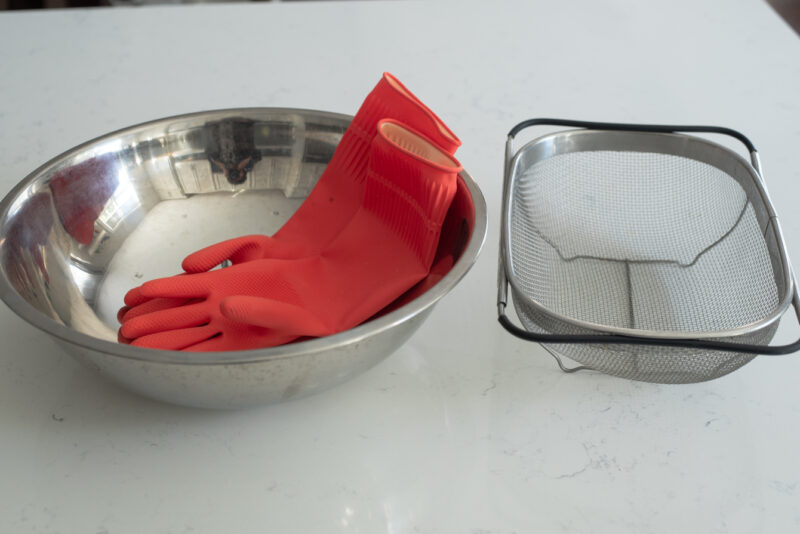
You don’t need special equipment to make this kimchi, but a few basics make the process easier: a large mixing bowl for salting, a colander for draining, kitchen gloves to protect your hands from gochugaru, and airtight jars with a little headspace for fermentation.
How I Make Everyday Napa Cabbage Kimchi
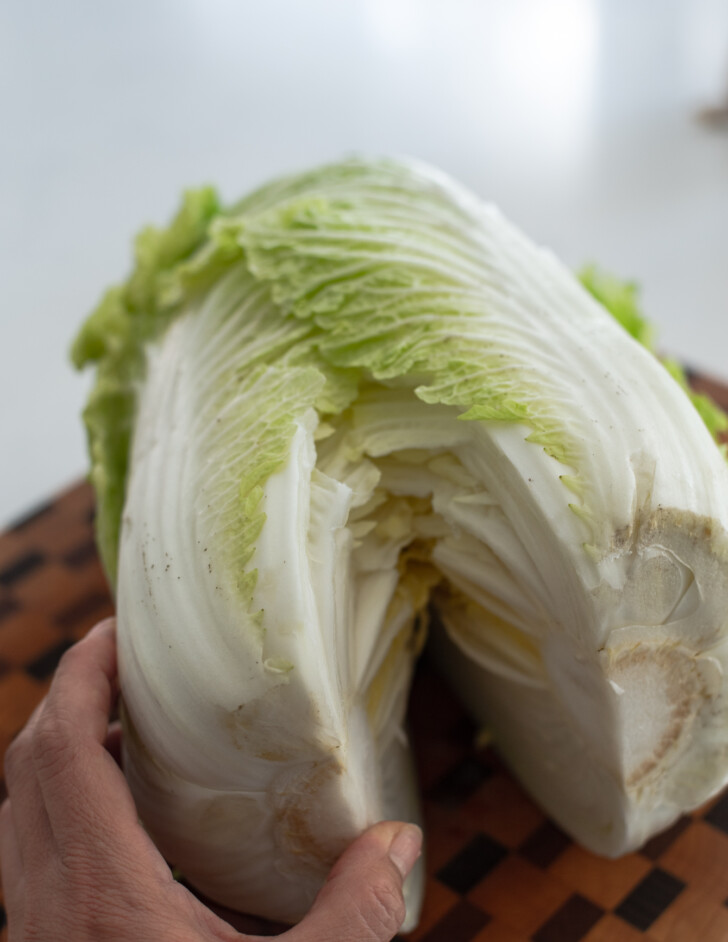
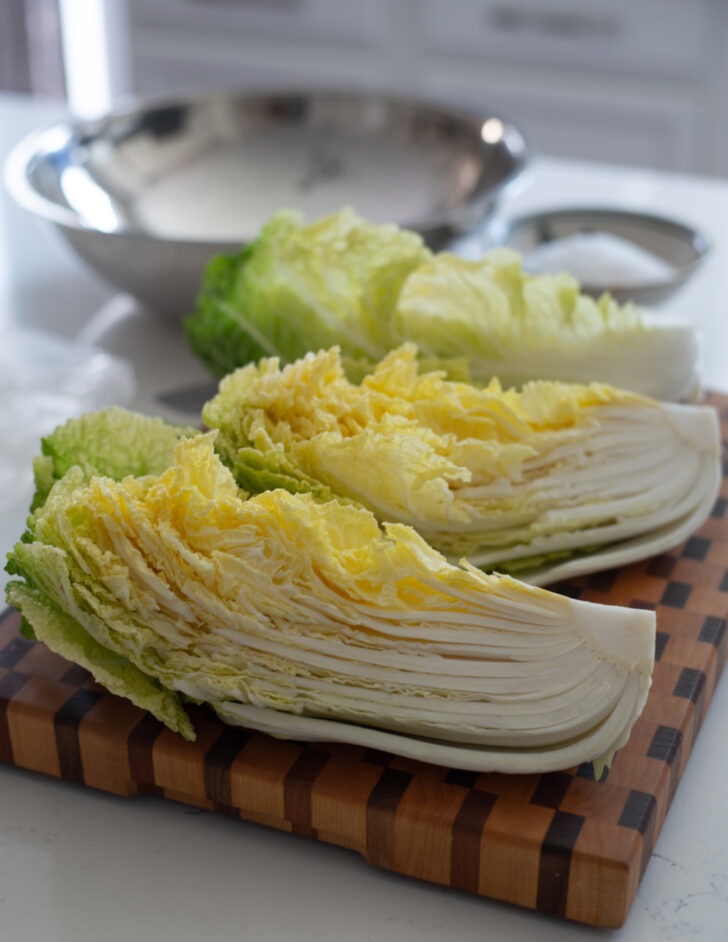
Prep the Cabbage. I start by quartering the napa cabbage the traditional Korean way—cutting a small slit at the base, then splitting it open by hand. This keeps the leaves intact and helps the cabbage ferment evenly later on.
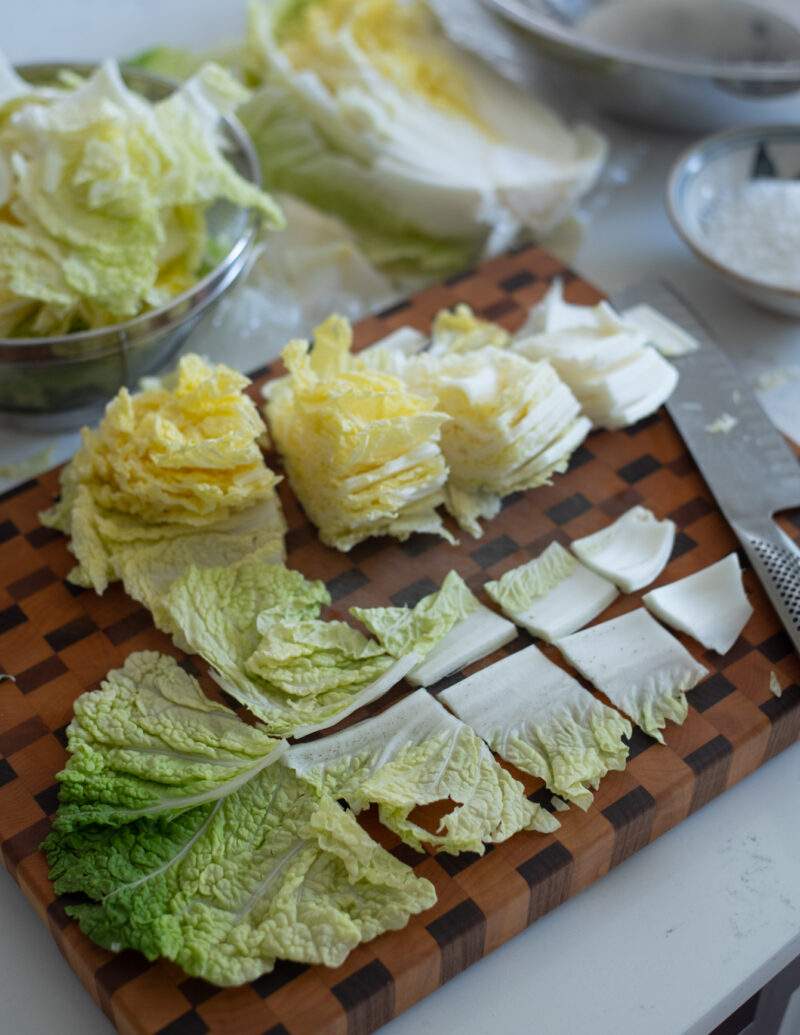
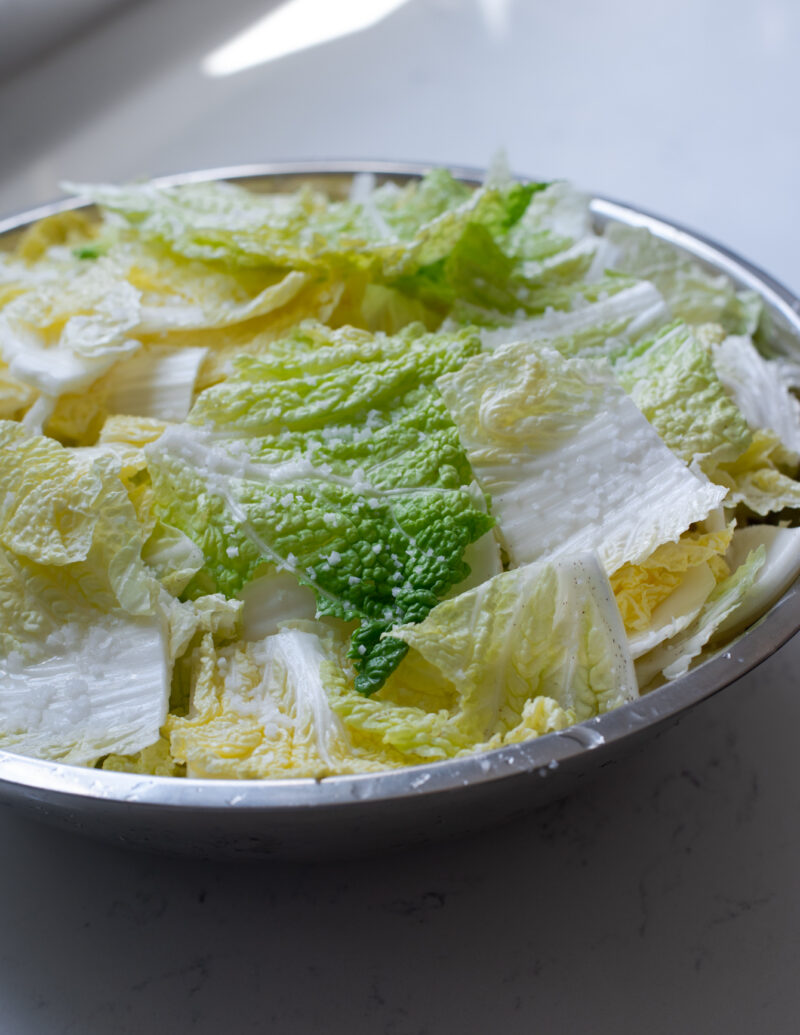
Salt the Cabbage. Cut the quarters into large chunks and layer them with coarse Korean sea salt in a large bowl. Make sure the salt reaches the thicker stem parts. Let the cabbage rest until the stems bend easily without snapping.
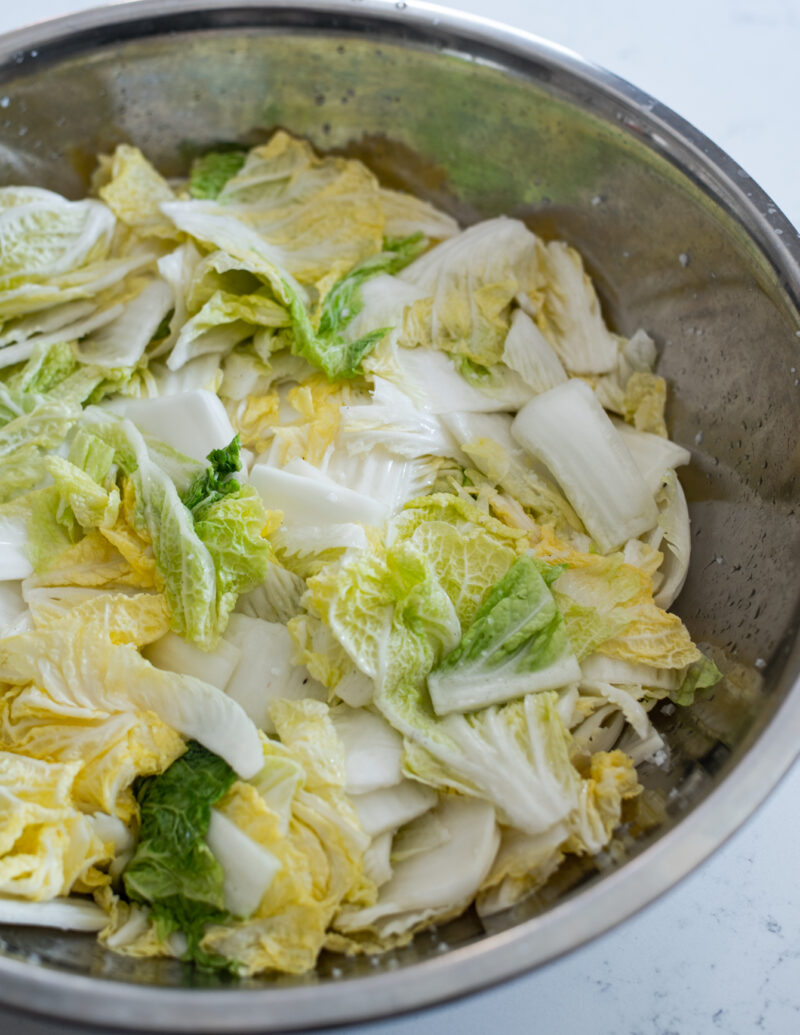
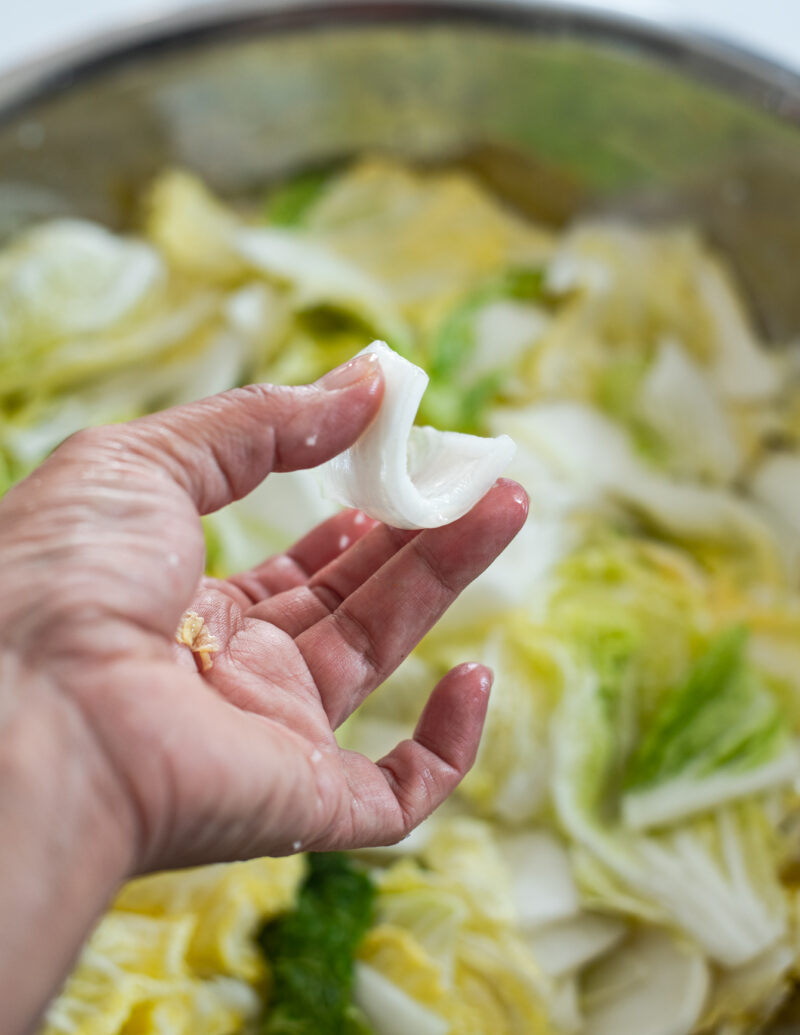
Rinse and Drain. Rinse the salted cabbage a few times to remove excess salt, then gently squeeze out the water. The cabbage should feel pliable but not waterlogged.
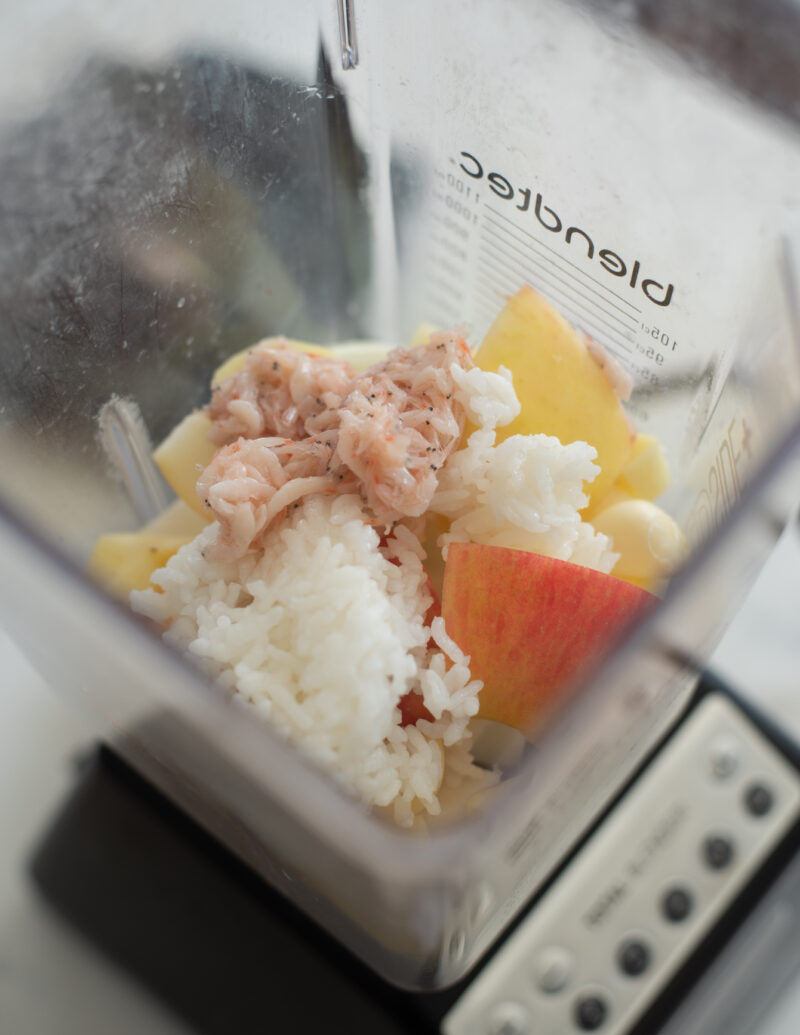
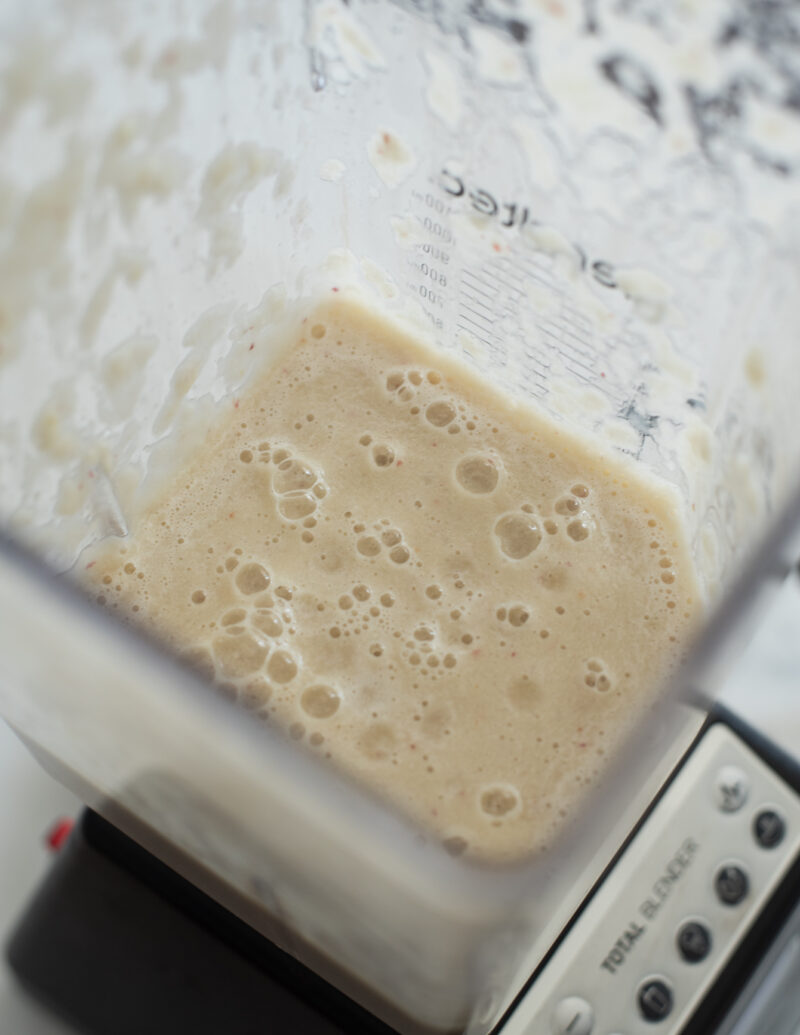
Make the Seasoning Base. While the cabbage rests, blend garlic, ginger, onion, apple or pear, a small amount of sugar, fish sauce, salted shrimp, and a bit of kelp stock if using. This base gives the kimchi depth and helps it ferment cleanly.
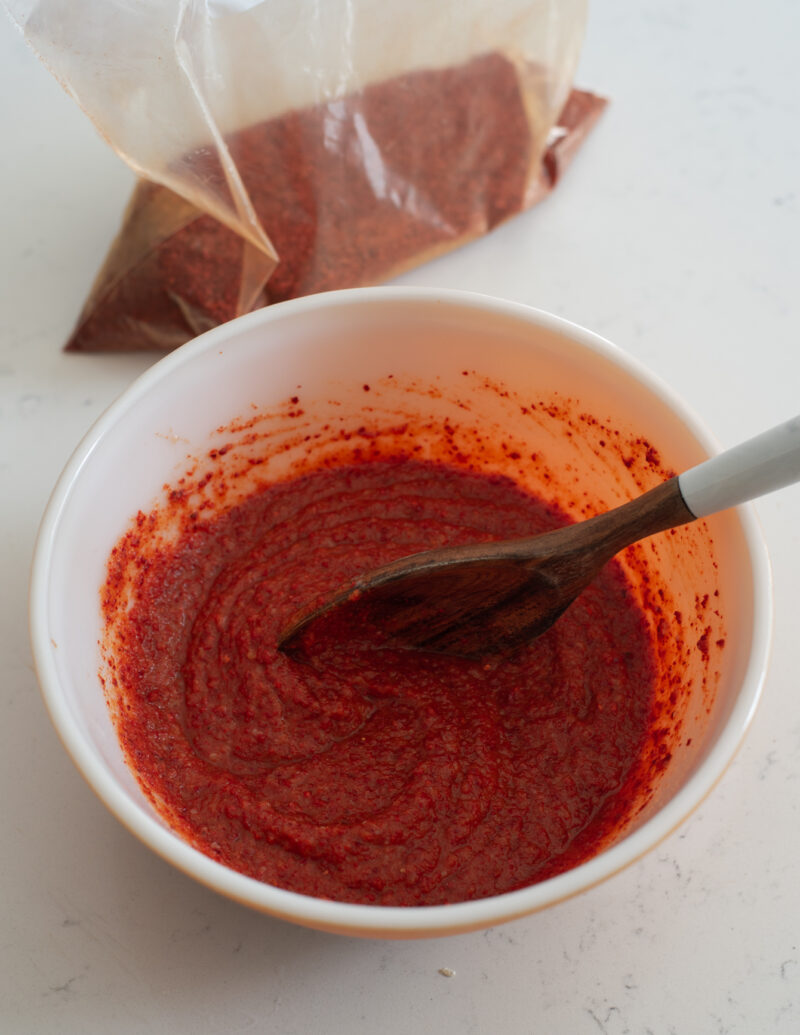
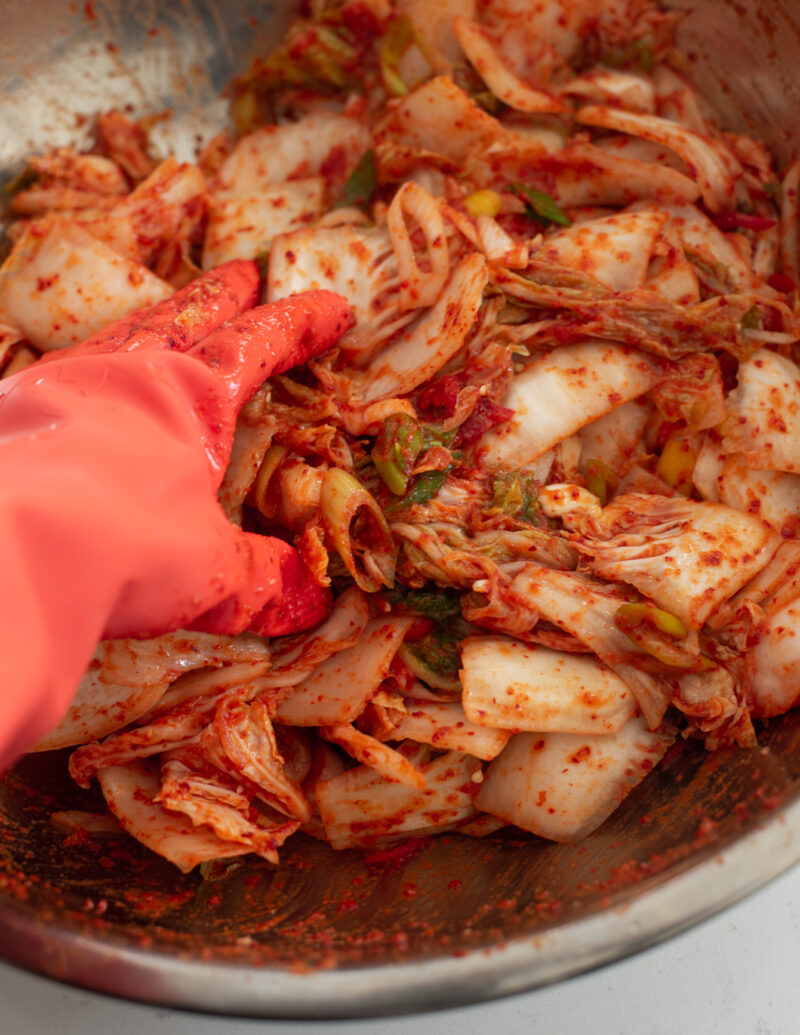
Mix and Season. Stir gochugaru into the blended base and let it sit briefly so the chili flakes bloom. Toss the drained cabbage with the seasoning paste and sliced green onions or leeks, coating the cabbage evenly.
Tip: I always wear gloves for this step—gochugaru stains and can irritate skin. The kimchi may taste slightly salty at first; it will mellow as it ferments.
If you’re looking for a fully plant-based version without fish sauce or salted shrimp, see my vegan kimchi, which follows the same fermentation principles using pantry-friendly substitutes.
How to Ferment and Store Kimchi at Home
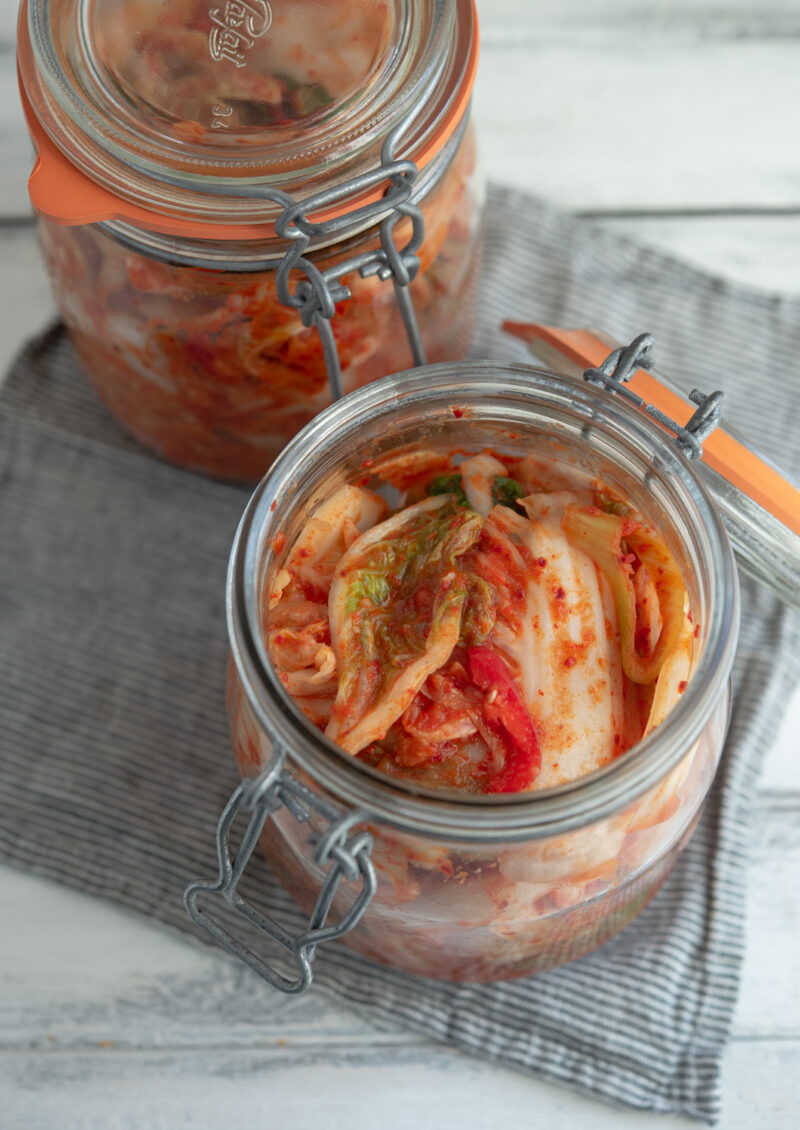
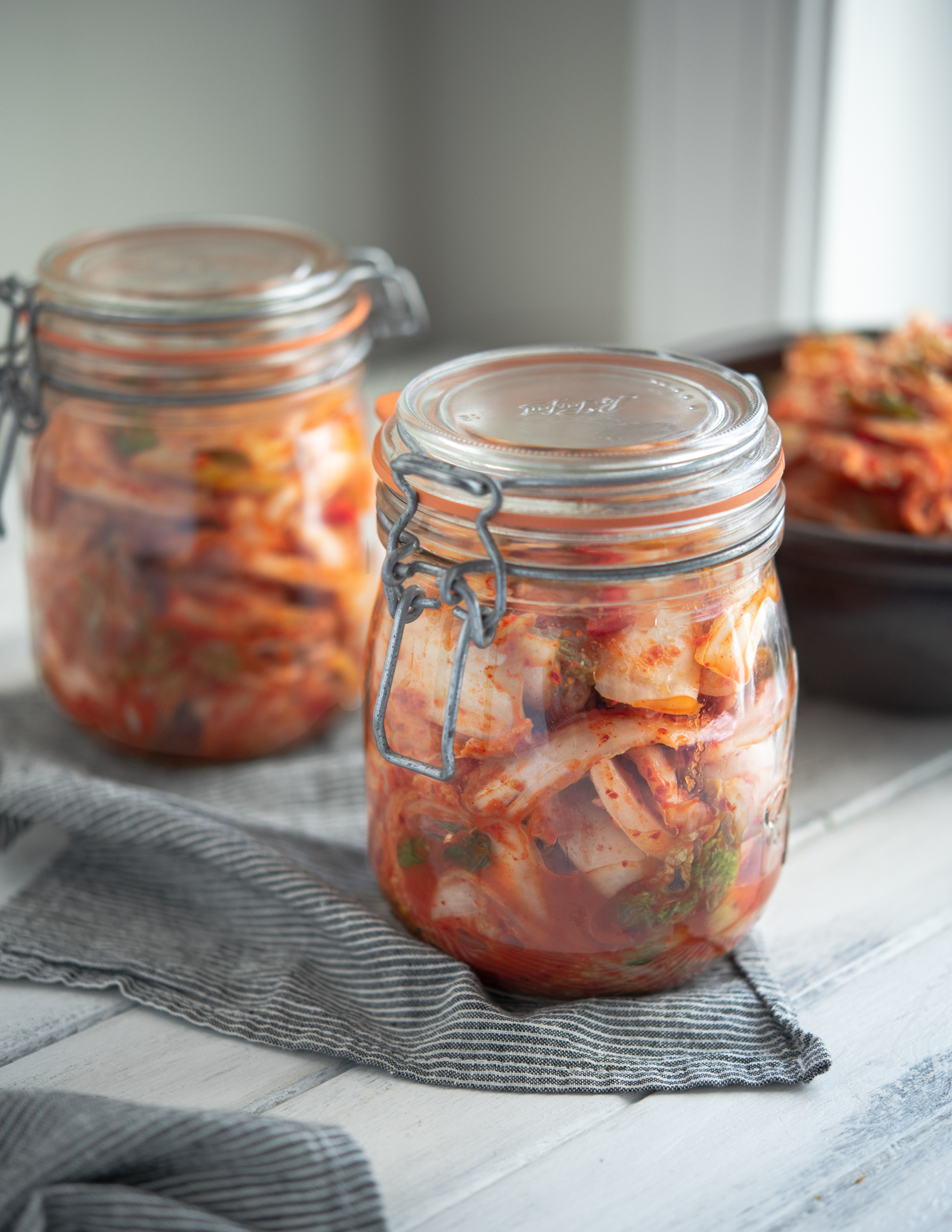
Once packed into jars, fermentation is what transforms the seasoning and cabbage into kimchi. I usually leave mak kimchi at room temperature for about one day—sometimes two if the kitchen is cool—until I see light bubbling and smell a gentle sourness. At that point, it goes into the fridge to slow fermentation.
Because the cabbage is chopped, mak kimchi ferments faster than whole-leaf kimchi. I like it best within the first few weeks, when it’s still crisp and balanced. As it ages, it becomes softer and tangier, which makes it better suited for cooking.
My go-to storage tips:
- Use airtight glass jars and leave headspace for expansion
- Press the kimchi down so it stays submerged in its juices
- Store it toward the back of the fridge where temperature is steady
As the kimchi becomes more sour over time, it’s especially good for cooking. Well-fermented kimchi works beautifully in dishes like kimchi jjigae, where deeper flavor is a plus.
If you want a same-day option without fermentation, make my geotjeori (fresh kimchi salad) and serve it right away.
For other styles and variations, browse my Korean kimchi recipes collection.
Love this recipe? Rate it and share your experience in the comments below! On Instagram? Tag me to showcase your creation. For more delicious recipes, subscribe to our newsletter!
Everyday Napa Cabbage Kimchi
Ingredients
- 3 lb (1.3 kg) napa cabbage, about 1 medium head
- 2/3 cup (200 g) Korean coarse sea salt
- 1 bunch green onion, sliced
- 2-3 fresh red chili (optional), sliced
For kimchi paste
- 1/2 large onion, diced
- 7-8 cloves garlic
- 1 inch (2.5 cm) ginger, peeled and diced
- 1/2 large sweet apple, seeded and diced
- 2/3 cup (60 g) Korean chili flakes (gochugaru)
- 1 tbsp (12 g) sugar
- 4 tbsp (60 ml) Korean anchovy sauce
- 1 tbsp (15 ml) Korean salted shrimp
- 3 tbsp (45 g) cooked white rice
- 1/2 cup (120 ml) sea kelp stock , or water (See note)
Equipment
- glass food storage jars 1 gallon (3.5 liter) airtight container
Instructions
To salt brine the cabbage
- Cut a 3-inch slit through the white stem part of cabbage. Open up the cabbage from the white stem part using your hand. It should open up easily. Cut additional slits on each cabbage half on the stem and open up again. By doing so, you are quartering the cabbage the Korean traditional way. Rinse the cabbage quarters once to wet them.
- Dice cabbage quarters into large chunks. For the large outer leaves, slice them in half lengthwise first, then dice into chunks.
- In a large bowl, put in a small layer of cabbage chunks and sprinkle about 2-3 tablespoons of coarse sea salt over the cabbage. Repeat the process several times, creating layers of cabbage chunks and salt.
- Let the cabbage soak for 1-2 hours, turning them upside down a couple of times during the soaking. When you bend the white stem part of cabbage, if it bends with a gentle pressure, the brine step is completed. Rinse the cabbage 3 times in water. Drain the cabbage in a colander, pressing down gently to remove excess water.
To make kimchi paste
- Combine onion, garlic, ginger, salted shrimps, fish sauce, cooked rice (or other choice of starch), and fruit in a blender. Pour in sea kelp stock (or water) to allow the blade to mix the ingredients. (If using fruit nectar, you don't need to add stock.) Process everything until smooth.
- Pour the puree in a large mixing bowl. Add Korean chili flakes, and mix well. Taste and adjust the seasoning of paste for your liking. Let the paste rest for 5 minutes, so the chili flakes will get re-hydrated.
To assemble kimchi
- Put the drained cabbage in a large mixing bowl. Add leek (or green onion), fresh chili (if using), and kimchi paste to the cabbage.
- Mix well to coat the cabbage with the seasoning paste. (Wear kitchen rubber gloves to protect your hands from getting stained or smelly.) Taste your kimchi! If your kimchi tastes saltier than you would hope for, don't worry! Freshly made kimchi usually taste much saltier, but the saltiness will subdue as it ferments.
To ferment and store kimchi
- Pack kimchi tightly into a clean glass jar, leaving 1 inch of headspace. Seal with a lid and let sit at room temperature (60–75°F / 15–24°C) for 1–2 days until light bubbling appears. Transfer to refrigerator and let ferment 4–5 days before serving. Best within 1–2 months.
Hi Holly!
I am really excited to find this speedy kimchi recipe! I have been following your blog and was super delighted for your detailed versions of kimchi.
I have ran through my local grocery stores and was unable to find salted shrimp (even in lottemart supermarket!) or even a possible substitute for it (e.g. cincalok like the malaysian one) and korean store is very difficult to find in my country.
Do you have any suggestions as to a substitute for the salted shrimp or perhaps if I could make them instead of buying?
Thanks heaps!
You can omit the salted shrimp. Increase the amount of fish sauce and you still will get tasty kimchi.
Hi Holly,
Thanks for the speedy reply.
I was gonna substitute korean salted shrimp with cincalok as I found someone selling it but they told me that in its raw state, cincalok tastes sour.
Instead I found lee kum kee shrimp sauce, saw it was made with shrimp and salt only (although not sure if they used the same small shrimp as korean salted shrimp) so I am gonna give that a go and see how it turns out.
I managed to found anchovy sauce in my local store so in case the lee kum kee shrimp sauce fails, for next batch do you mean I should increase anchovy sauce (by how much?) or use thai fish sauce? Thanks heaps!
Can’t wait for more recipe updates from you, your recipes are really easy to follow and the pictures are just beautiful. <3
The shrimp sauce you mentioned almost sounds like thin belachan to me. Belachan is quite strong to add as it is without being cooked to kimchi since it has very potent smell. Although Lee Kum Kee shrimp sauce looks thinner and maybe less potent? I am not sure.
I will tell you what. Make kimchi filling without the shrimp sauce in the recipe. Take a small portion off from the filling and add in a little bit of the shrimp sauce to it. Taste both filling to see if you can tell the difference. The kimchi filling with or without shrimp sauce won’t have much difference in taste as a filling but it will make a little difference as it ferments with cabbage with it.
If your filling with LKK shrimp sauce taste like (or smell like belachan), I wouldn’t use it. You can make a very decent batch of kimchi without shrimp sauce if you add the seafood stock in the filling, which will make up the flavor.
Most Korean fish sauce is made with anchovies. I think it is a good idea to mix Korean fish sauce with Thai/Vietnamese fish sauce. I personally never tried Thai fish sauce to make kimchi but Many Koreans in abroad do. It works but I highly recommend to use 30-50% less depends on the brand. Check the sodium level. Most Korean fish sauce is about 25-35% sodium intake per serving, and I’ve seen some Thai fish sauce goes upto 70% which is extremely salty. Start with less portion of fish sauce. You can always add more even after you mix the cabbage with the Kimchi filling.
Good luck, Anasthasia! Kimchi making is not an easy task but is very rewarding. I would love to hear how your turns out. Thanks for the compliment. 🙂
Hi Holly,
I have made it! and the flavour is great and I used the LKK shrimp sauce.
I tried it on a small batch and it tasted more delicious with it (sort of add that depth of seafood flavour) so I added it to the rest.
It’s been about 2 days and the kimchee flavour is wonderful although mine turn out very sour not sure why exactly but I have been adding sugar gradually to try to reduce the sourness but up to now it is still quite sour. I think maybe I should have taken the cabbage out of their salt water soak bath faster than the given time.
Thank you for your recipe! Will definitely make it again next time, now I can just make my own kimchi and I won’t have to buy from the store since the ones available here are not so nice.
Yeah! that is great!
I am so glad to hear that the LKK sauce worked very well in the recipe.
I think the reason your kimchi went too sour is either the cabbages were not fully soaked in the salt water, or maybe your room temperature is too warm during the fermentation. The fermentation level can vary depends on the surrounding temperature. In the summer time I usually leave my kimchi only a day in the room temperature, then store in the fridge. They will continue to ferment in the fridge but slower in the speed.
Homemade kimchi tastes much better than store bought for sure!
Thanks for the update, Anasthasia!
Hi! Holly,
Firstly,Iam so Sorry my english is poor.
Thanks for da recipe! I already tried. simple and taste also good (^_^). Me and my freind really like to try korean dish. We were so addicted with kdrama. lol.
I can’t wait to try this, just looked up a Korean store near me. Love me some Kimchi.
Thank you so much for this recipe! I LOVE kimchi, but have been hesitant to try making it because I live in a place where its hard to find the right ingredients. This recipe had things that I could find or easily replicate…. So I tried it!
When I had it all stuffed in a jar, I tasted it…. OH! it was soooo awful!! haha I thought maybe I just dont like ‘fresh’ kimchi. So I let it set on the counter a night, but it was still awful. I put it in the frige for a week and tried again… it was just not good at all! But, it was so pretty and I had made so much, I couldnt throw it away.
It sat in the back of my frige for about a month… taunting me. Till one day I dared a taste and oh em gee…. IT WAS DELICIOUS!! Wow…. really just wow. its sooooo good! Ive eaten half the jar in the last few days. Its great right out of the jar or in cooking. I love it! THANK YOU! Ill never buy kimchi again <3
Hi Holly,
I stumbled upon yr blog while searching for recipe on citreon tea. I have been an ardent fan for korean food and love eating kimchee. After reading your kimchee recipe, i would like to try making it. It sounds interesting and easy to make since you have explained them very clearly. Thank you very much for the recipe. I am glad that I have finally found a step by step and easy to follow recipe.
Thank you SK Lee. Hope you can give a try on kimchi making. It requires some time but worth it. Take care!
Thanks for your recipe! I wanna know how much salt I should use if I use fine sea salt? And how much salt and chili flakes is appropriate if I want to make it more bland but still has taste? 감사합니다:)
If using fine salt, perhaps cut down about 1/2. Also you can use less chili to make it blend, up to 1/2 the amount but your kimchi won’t be as red/orange. I would cut down about 30%.
Hi Holly,
Thank you for sharing this recipe. I love Kimchi I bought every two months but I don’t know how to make. I am please to find your recipe so clear with photos so I could understand what the ingredients to use how is look like. I am from Vietnam living in Dhaka. There is Korea supermarket I think I could find all the ingredients there. Thank again.
Hi Holly!
I ran into your blog and got curious,since I love trying new food. I’m a Filipino and my problem would be where to find some of the ingredients of Kimchi I really wanted to try it and taste the very famous food of Korea. I’m very excited to try and taste it..
Hi Noemi
Best place to get Kimchi ingredients will be Korean grocery stores. I believe there would be some in Manila since there are many Koreans living there. You should be able to find Korean chili flakes, fish sauce, shrimp sauce, and maybe, even cabbages.
Hi Holly, I stumbled upon your website to make kimchee. I linked your blog to my post. I am in the process of trying it myself. Thank you for sharing your recipe.
Hi, I’m a kitchen newbie and I’m going to try more recipe from your blog after my first successful spicy dummy pork. ^_^
My location is in Penang Malaysia, if I can’t get the korean salted shrimp paste, can I replace it with the cincalok? As I saw the ingredient is also shrimp and salt.
I have seen them at the store. Never tried though but if they are just shrimp and salt, it should work. I am glad that you liked my pork recipe. Good luck on making kimchi. I am visiting Penang in December and I am quite excited.
I am going to make kimchi this weekend, but can I use rice flour with this recipe instead of rice??
Of course. You need to cook into rice glue to add to the filling, though.
Thank you very much.. I recently soak cabbage in salted water. I am so excited:-)
I have one question, I coudn’t find anchovy sauce, can i use fish sauce?
Many thanks.
Charos
Yes, you can use fish sauce. But use a little less amount if the fish sauce has more sodium (usually Thai fish sauce is quite salty). You can always add more if you need.
Thank you. I put too much onion in mine (I don’t know why) but it is soo good!
Glad that you liked it. You can never put too much onion. I love onions!
Hi Holly! I’ve recently started following your blog and I wanted to tell you how lovely it is. My husband is American (I’m British) and we lived in Seoul for 2 years back in 2002. We fell in love with the food and I miss it terribly, especially now that we’re living in London and it’s not as easy to get good Korean food. I’m thrilled to see this recipe for easy kimchee since I crave it ALL the time. I could eat it every day. Now I have to find somewhere to buy the ingredients…
Hi Emily, I am glad that you found my blog, too. I hope you can find some good Korean ingredients to make your kimchee soon.
Thanks for this recipe!
I’ve made a few mak kimchi recipes before and so far this one is my fave, especially with the leftover rice tip. Though I had to make some adjustments (forgot to get ginger, out of fish sauce so I used soy sauce, instant dashi instead of anchovy stock, and I only used green onion and added strips of radish), it turned out wonderful! I also appreciate the tip on saving the leftover paste and using it for a quick kkadugi, which I did and is also delicious.
I just really need to get my hands on some good Korean sea salt, and better cabbage next time, though that’s hard to find here. I think I’ll grow it in the garden next year, maybe even this year though it’s a bit late to start from seed. Hm.
Thanks again! I love your blog.
Hello Holly !
I had spotted your 3 posts about making the long version a long time ago but was hesitant given the complexity. I finally tried this fast version and it gave amazing results ! Now we are trying the concumber..
Do you think it is possible to make brocoli-kimchi ? I would love to mix crunchiness and spiciness ! Do you think it is better to drown it into salted water, or to cover it with boiling salted water like the concumber ??
thank you for your advice
greetings from Paris !
Hello Thomas
Yes, it is possible to make broccoli kimchi. You wan to sprinkle a little bit of (about 1-1 1/2 tablespoon) coarse sea salt over 1 head of broccoli and let it sit for about 15 minutes so that broccoli gets pre-seasoned. Rinse and spin well to get rid of moisture. Add chili fillings and toss.
I am so glad to hear that the easy kimchi version came out great for you.
Jessica
I am so happy to hear that your kimchi turned out so well. It looks really good from the photo. Yes, you should be in the kimchi business.
For the mandu, try chopping your noodle smaller. Easier to assemble that way. Also maybe reduce the amount of tofu and increase the pork. It will be quite bland to taste if there is too much tofu. You can always adjust amount of each ingredient for your liking. Don't forget the dipping sauce, either!
Thanks for taking your time to write me. Comments from my readers like you do motivate me to continue the blogging.
Hi, Holly!
I wanted to let you know my kimchi was a big success and now my husband's family are teasing me that I should have a kimchi business! One sister-in-law told me she didn't expect my kimchi to look so professional, my husband told me it tasted authentic and everyone raised their chopsticks with kimchi in an ode to kimchi during our lunch. 🙂 We also tried your mandu recipe, but I think I need to practice that some more as it was pretty bland, and my filling wasn't small and even enough. Here's a picture of my kimchi and the family making mandu! Thanks for your recipe and for explaining it step by step, making it easy for this Mee-gook mind to follow along! 🙂
Kam-sam-needa!
Fresh taste! I Surfing your yummy blog.
Thanks Mary. I am glad that you found my site. Hope you can find a good recipe in my blog that you can try. Let me know if I can help you with anything.
Thanks, Holly! After looking at the printed recipe, I realize you had written some of the details that I was asking about. Oops! Sorry to make you repeat yourself. I'm so excited to try this. I had to special order the Asian cabbage since K-town only sold boxes of 50 heads of cabbage! I've been slowly gathering the ingredients with the help of a Korean girlfriend and hope it turns out well! I will let you know. 🙂
Hi Jessica
If you are using Veitnamese fish sauce, use about 2 tablespoon first along with Korean salted shrimp in the recipe. As for the leftover rice, use about 1/3 cup (room temp).
After you make kimchi with cabbage, taste it to check the seasoning. It should be slightly saltier that you would hope for. The water in the cabbage will continue to ooze out and dilute the sodium level. You can always add more fish sauce if you need.
Leave kimchi on the counter 1-2 days to ferment (no more than 2 days, otherwise it will be too sour), until you see a little bubbling gas forms, then, put in the fridge to slow down the fermentation.
Good luck! and let me know how it turns out.
Hi, Holly!
I'm an American married to a Korean man and excited to try this mak-kimchi. Thanks so much for posting it! I'm actually making it this week to take to a Korean family gathering this weekend.
Can you please tell me how much Vietnamese fish sauce I can use for the stock since I don't have anchovies? Also, can you tell me how much leftover rice I should use in the rice paste? I don't have time to practice, so hope to get it right the first time!
Also, will 3-4 days be enough time to ferment?
Thanks in advance!
Jessica
you know that this cabbage here is called "Pekin cabbage"?:)