

Authentic Tteokbokki (Korean Street-Style Spicy Rice Cakes)
Tteokbokki comes together in under 25 minutes with this tested one-pan street-food recipe. Chewy rice cakes simmer on the stovetop in a glossy gochujang sauce layered with fine gochugaru, brown sugar, and savory stock. A quick, satisfying dish perfect for a weeknight meal simplified for your home kitchen.
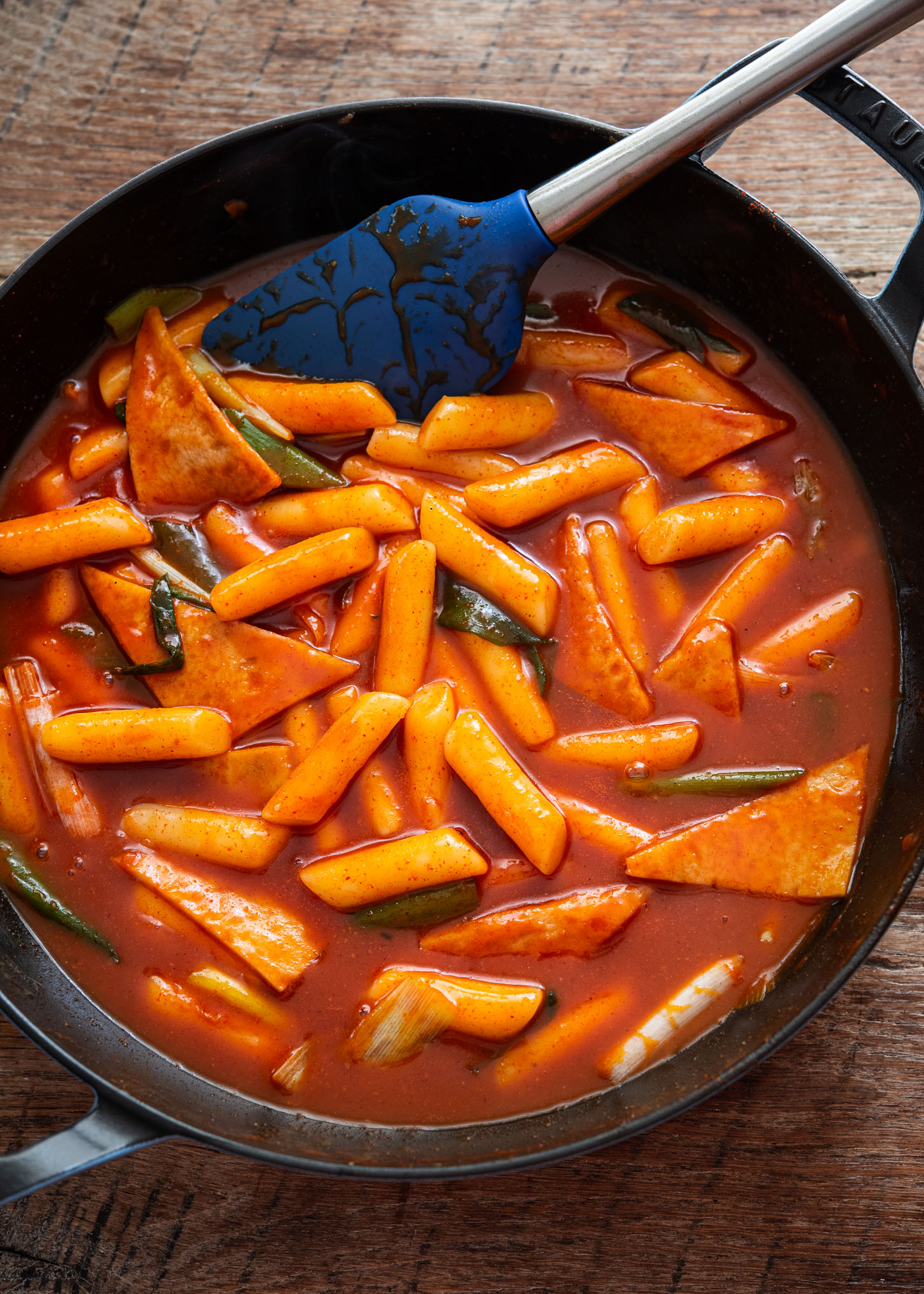
Tteokbokki should be bold and deeply savory, never overly sweet or diluted. This version follows the traditional street-style method, building the sauce with anchovy stock and fine gochugaru for depth and clean heat.
The key is reduction. The sauce simmers until it thickens just enough to coat the rice cakes without turning pasty. The result is balanced — spicy, slightly sweet, and layered with umami — the way it tastes from Seoul street carts.
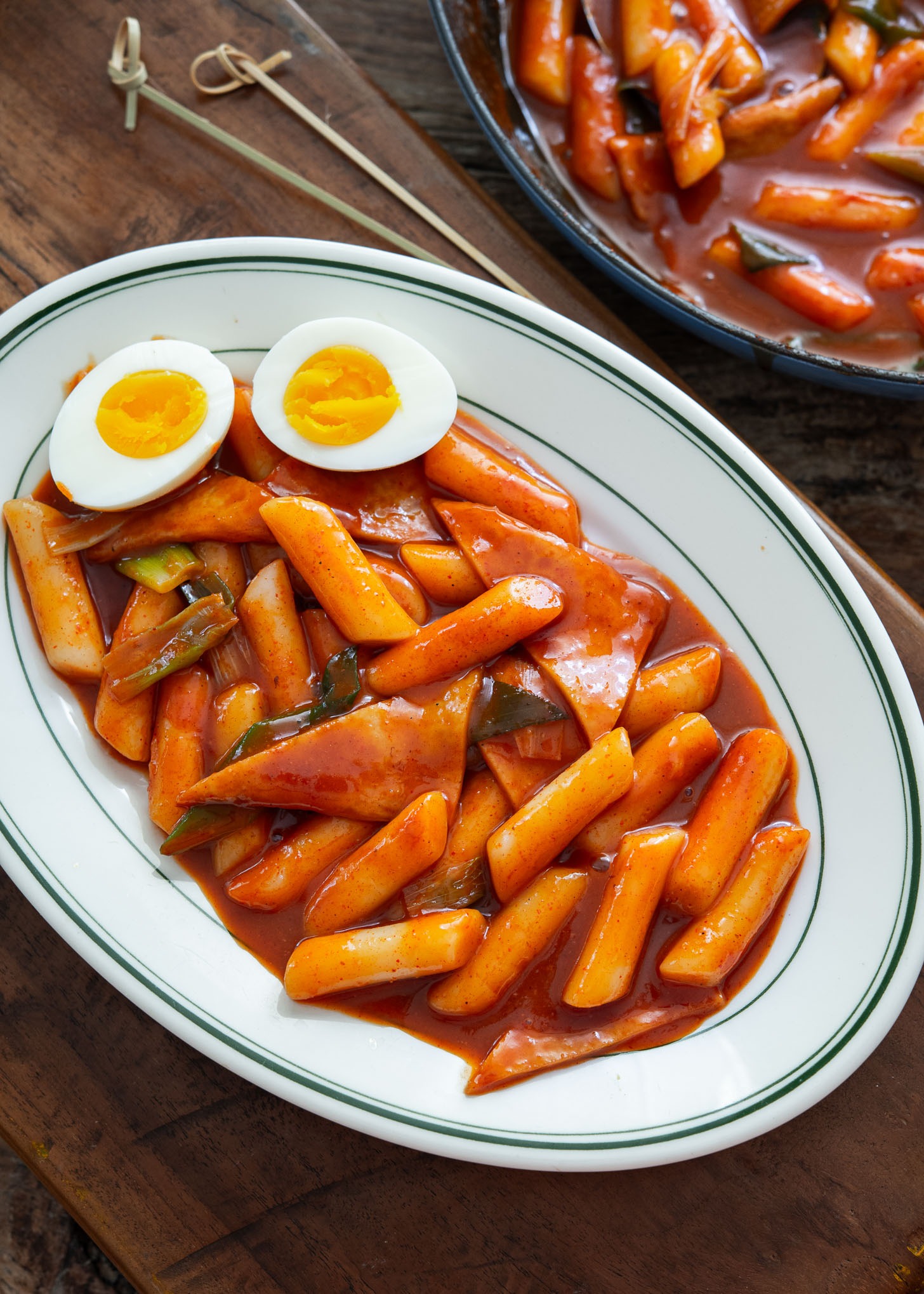
If you’ve ever walked through markets in Seoul in the late afternoon, you’ve likely smelled the irresistible, spicy aroma of tteokbokki (떡볶이) bubbling away at a street cart. That’s the memory I always return to when I’m in my kitchen—the sauce thick and glossy in the cool air, and the simple joy of that first chewy bite.
I’ve spent over 15 years refining this recipe to make sure it captures that exact ‘street-style’ soul. It’s a favorite in my home, and I even included a similar version in my cookbook, Korean Cooking Favorites, because I believe every cook should have a fail-proof way to make this at home.
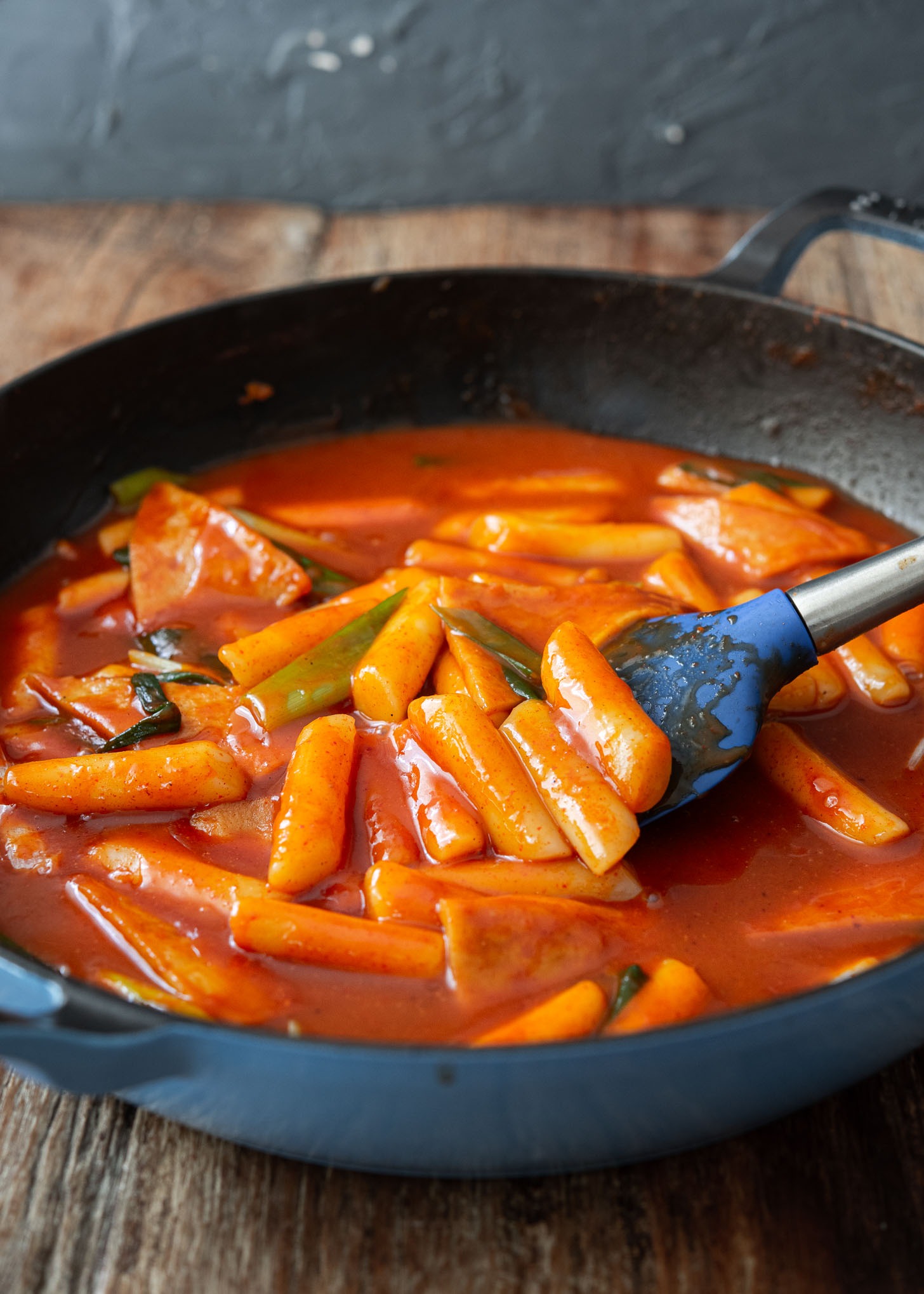
In this post, I’ll show you the small techniques I use, like the specific stock base and reduction method, to make sure your sauce is perfectly balanced and never too sweet. With my step-by-step photos and video below, you’ll see exactly how the sauce should look as it thickens.
These days, tteokbokki comes in many versions; from creamy creamy Rose Tteokbokki for a milder, trendy twist to the savory Gungjung Tteokbokki (Royal Court style) for a non-spicy alternative. I love them all, but nothing replaces the classic gochujang-based version that I grew up with.
The Flavor Technique That Sets This Tteokbokki Apart
I’ve been making and refining this version for over a decade, and it remains the one I return to most. It stays grounded in classic bunshik style, rice cakes simmered in a gochujang-based sauce with fish cakes and Korean leeks.
- I use fine gochugaru rather than coarse. It produces a smoother sauce and a deeper red color that coats the rice cakes evenly instead of separating.
- A small amount of onion powder adds savory depth beyond gochujang and sugar alone.
- Brown sugar replaces white for a more rounded sweetness that blends instead of sitting on top.
- Most importantly, the sauce starts with anchovy stock (myulchi yuksu). It doesn’t make the dish taste fishy — it creates structure and depth, allowing the spice to feel layered rather than sharp.
- Proper tteokbokki is never syrupy or candy-sweet. The balance should lean savory with controlled heat and a clean finish.
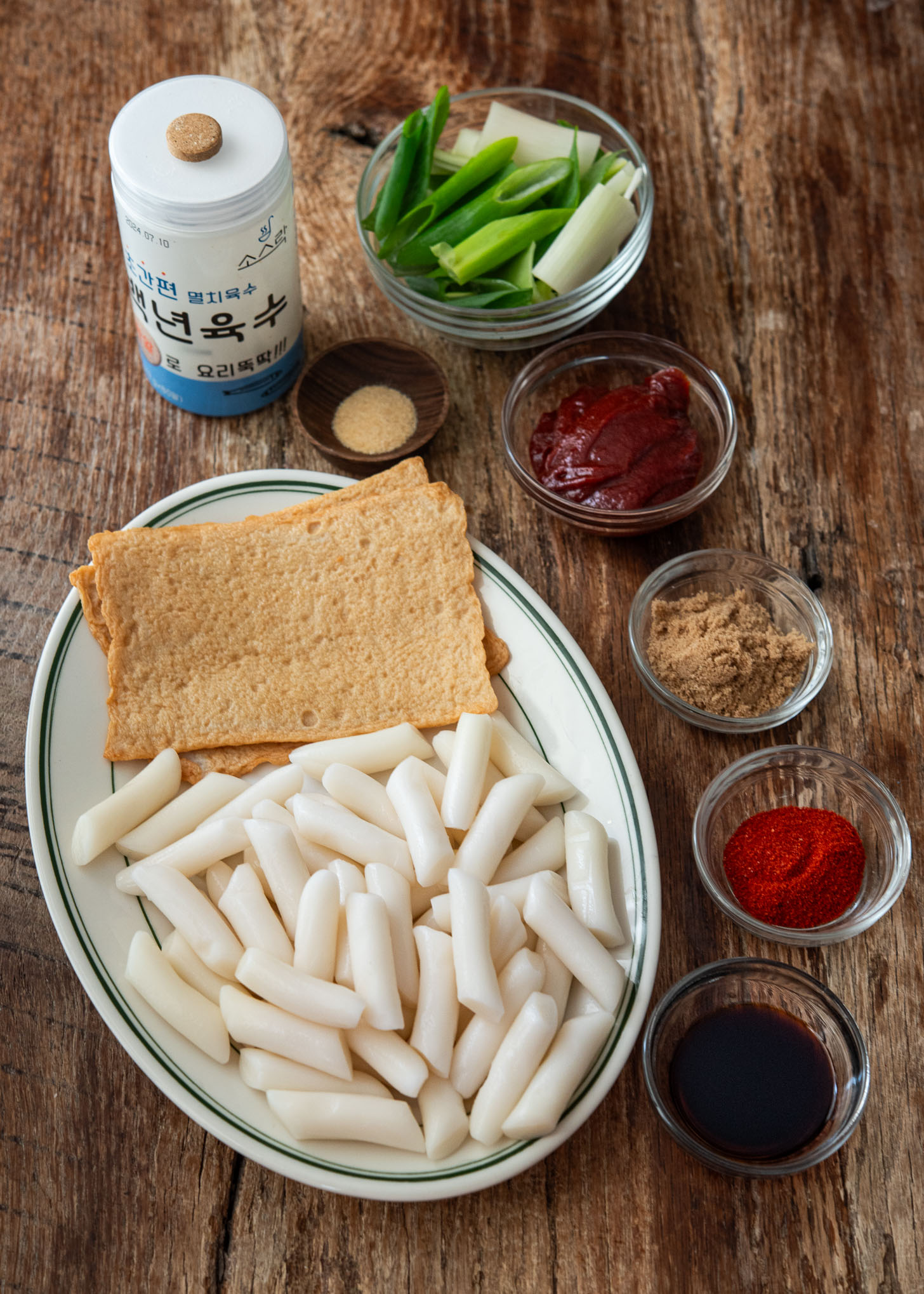
Key Ingredients for Authentic Tteokbokki
Great tteokbokki relies on a handful of ingredients. Each one affects texture and depth, so quality matters.
Rice Cakes (Tteok, 떡): Use garaetteok, the long cylindrical rice cakes made specifically for tteokbokki. Fresh or vacuum-sealed both work. If refrigerated, soak briefly before cooking so they soften evenly.
Fish Cakes (Eomuk, 어묵): Thin, flat sheets are traditional. They add light chew and absorb the sauce as it reduces. Slice into triangles or strips for even cooking.
Korean Leek (Daepa, 대파): Thicker and more aromatic than Western green onions, daepa brings mild sweetness as it simmers. Large green onions can substitute if needed.
Anchovy Stock or Korean Stock Coin: Tteokbokki should be built on anchovy stock (myulchi yuksu). When short on time, a Korean stock coin dissolved in water provides similar depth. It creates a savory base without overpowering the sauce.
- For Vegetarian/Vegan option, swap the anchovy stock for dried kelp (dashima) stock and skip the fish cakes.
Gochujang and Gochugaru: The sauce depends on both. Gochujang provides body and fermentation depth, while fine-grind gochugaru smooths the texture and intensifies the red color.
How to Cook Tteokbokki
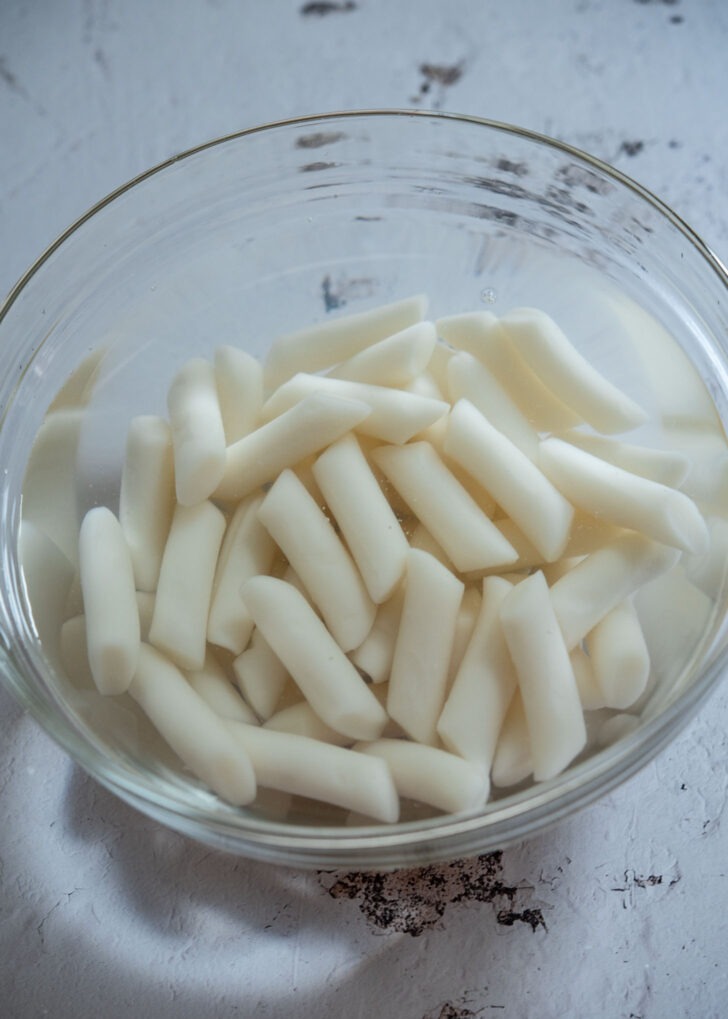
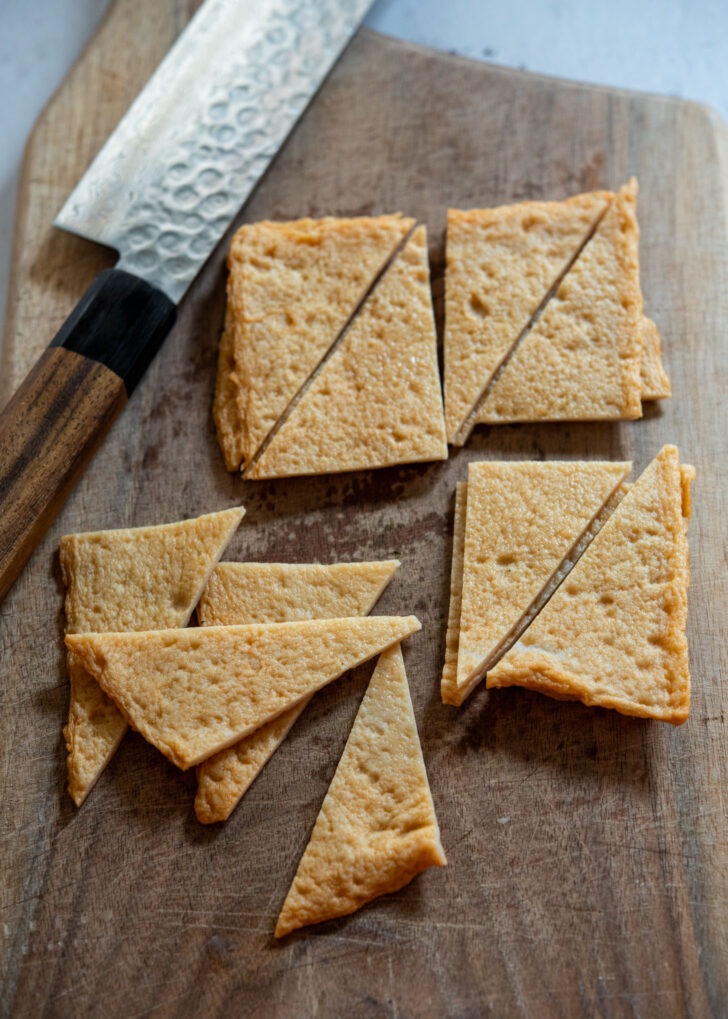
Prepare rice cakes and fish cakes. Soak refrigerated or frozen rice cakes in warm water for about 10 minutes, then drain. This helps them cook evenly and stay tender. Slice the fish cakes into medium strips or triangles so they heat through quickly and absorb the sauce.
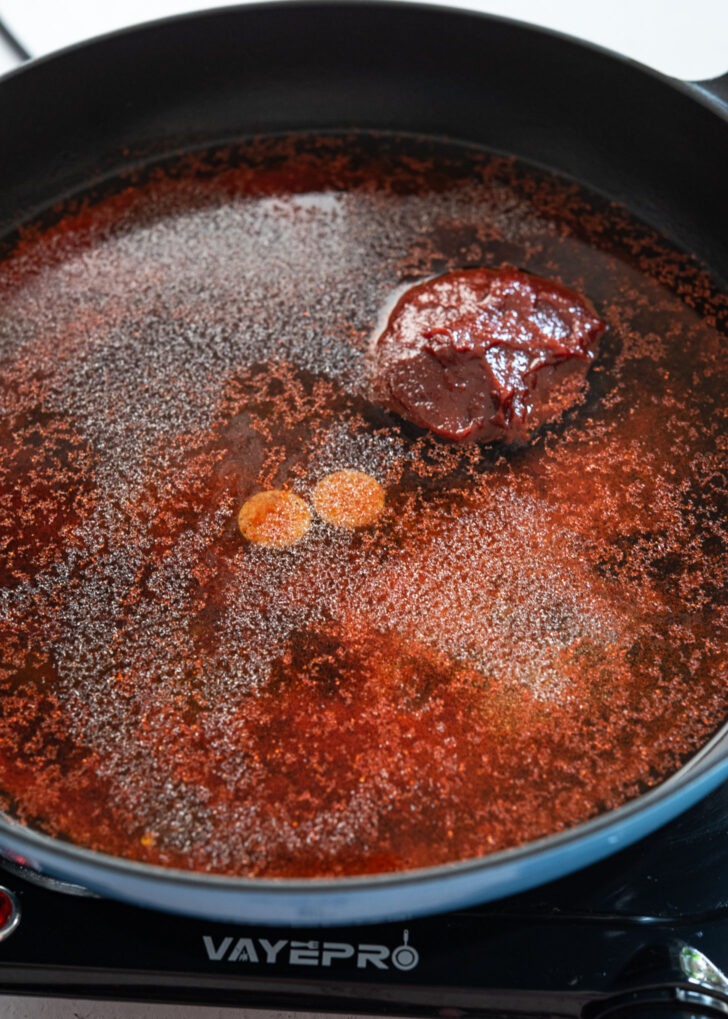
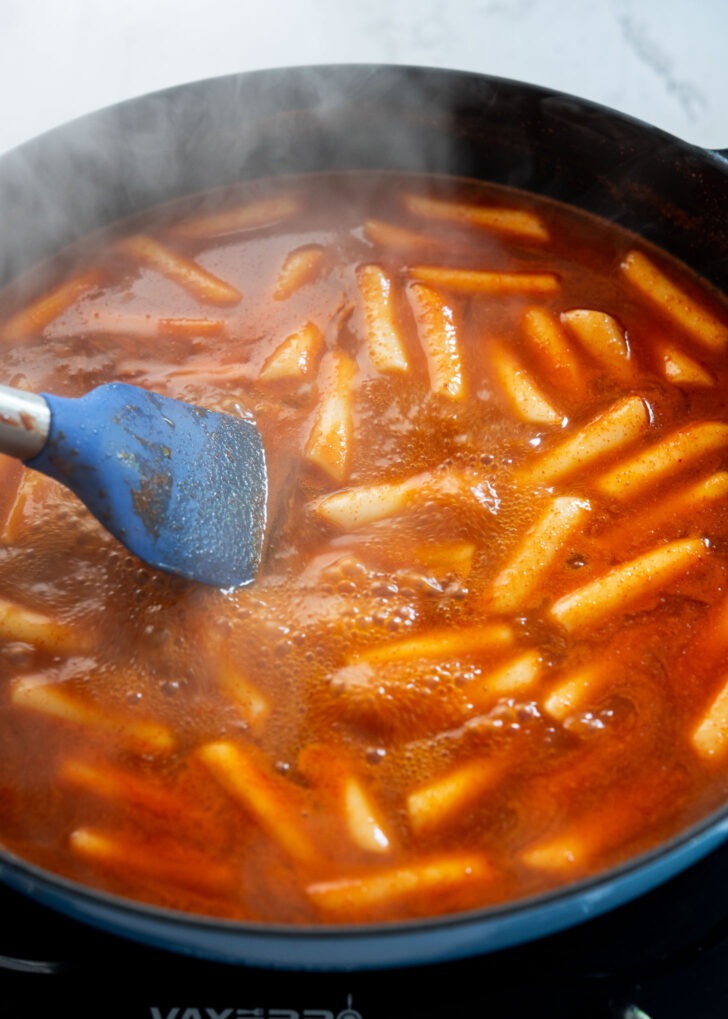
Simmer the sauce and rice cakes together. Bring the sauce base to a steady simmer in a wide skillet until fully dissolved. Add the rice cakes and cook at a controlled simmer, stirring occasionally to prevent sticking. As they soften, the starch will lightly thicken the sauce. Let it reduce until it begins to coat the rice cakes.
Hyegyoung’s Tip: You’ll know rice cakes are done when they look slightly swollen and feel tender all the way through.
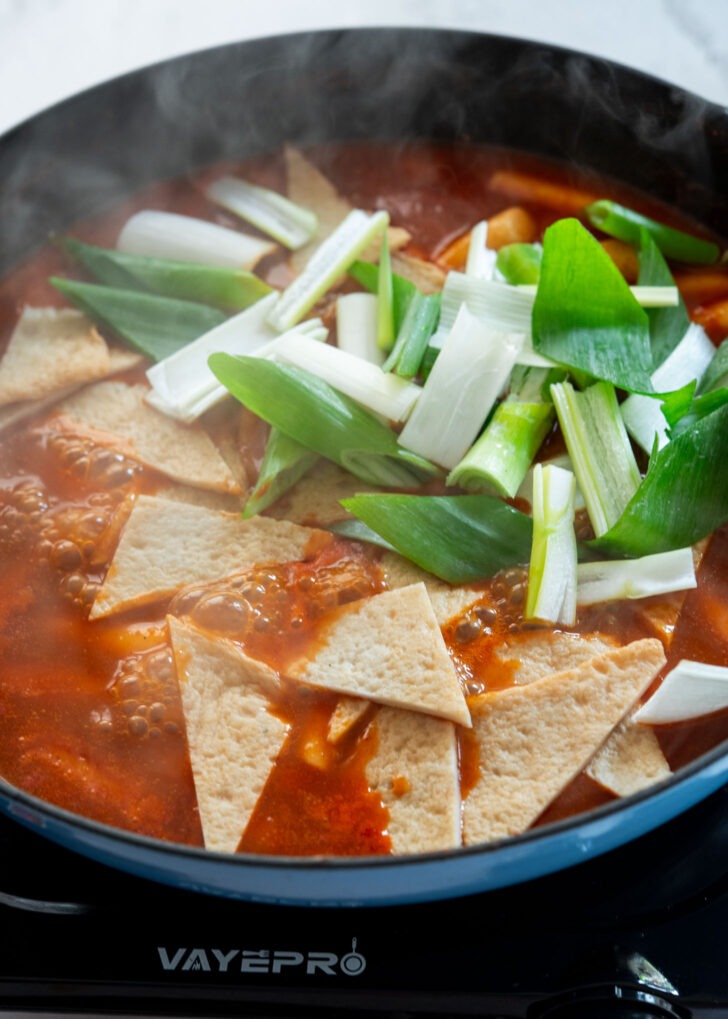
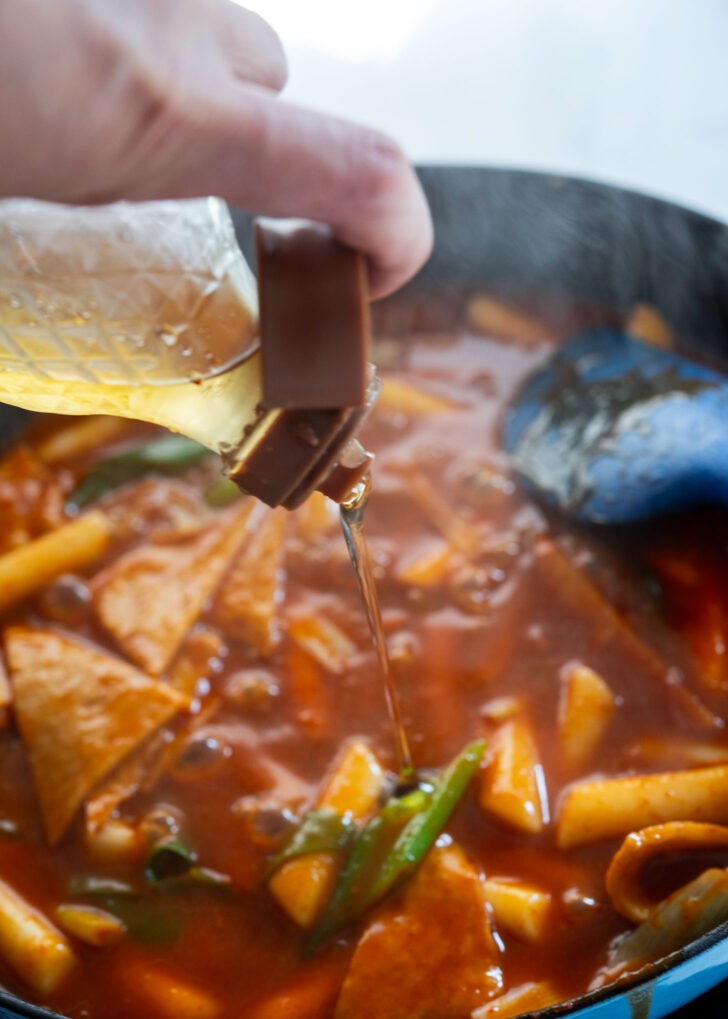
Add the fish cakes and leeks. Add the fish cakes and sliced Korean leeks once the rice cakes are tender and the sauce has reduced. Simmer briefly until everything is heated through and coated. Stop cooking when the sauce clings but still moves slightly in the pan. It will continue to thicken as it cools.
Optional Tip: A small drizzle of oligo syrup at the end adds gloss without increasing sweetness significantly.
Serving Ideas
Tteokbokki is commonly paired with crispy homemade Mandu (Korean dumplings) or deep-fried Gimmari (seaweed spring rolls) for dipping. The contrast of tender rice cakes and crispy sides makes the dish more satisfying.
A sliced hard-boiled egg is another classic protein addition, and serving it with classic Kimbap to make it a complete meal. These combinations are typical of bunshikjip menus, where quick, affordable dishes are designed to be mixed and matched.
Tteokbokki is the star of the show, but the best part of Korean market culture (bunshik food) is the variety. I’ve gathered all my essential Korean street food recipes in one place so you can recreate that bustling market energy right at home.
Reheating Leftovers
Rice cakes harden as they cool. To enjoy leftovers, reheat them on the stovetop with a splash of water or stock to loosen the sauce and soften the cakes again.
This recipe was originally posted in April 2010. I’ve updated the recipe with a few changes, new photos, and more information.
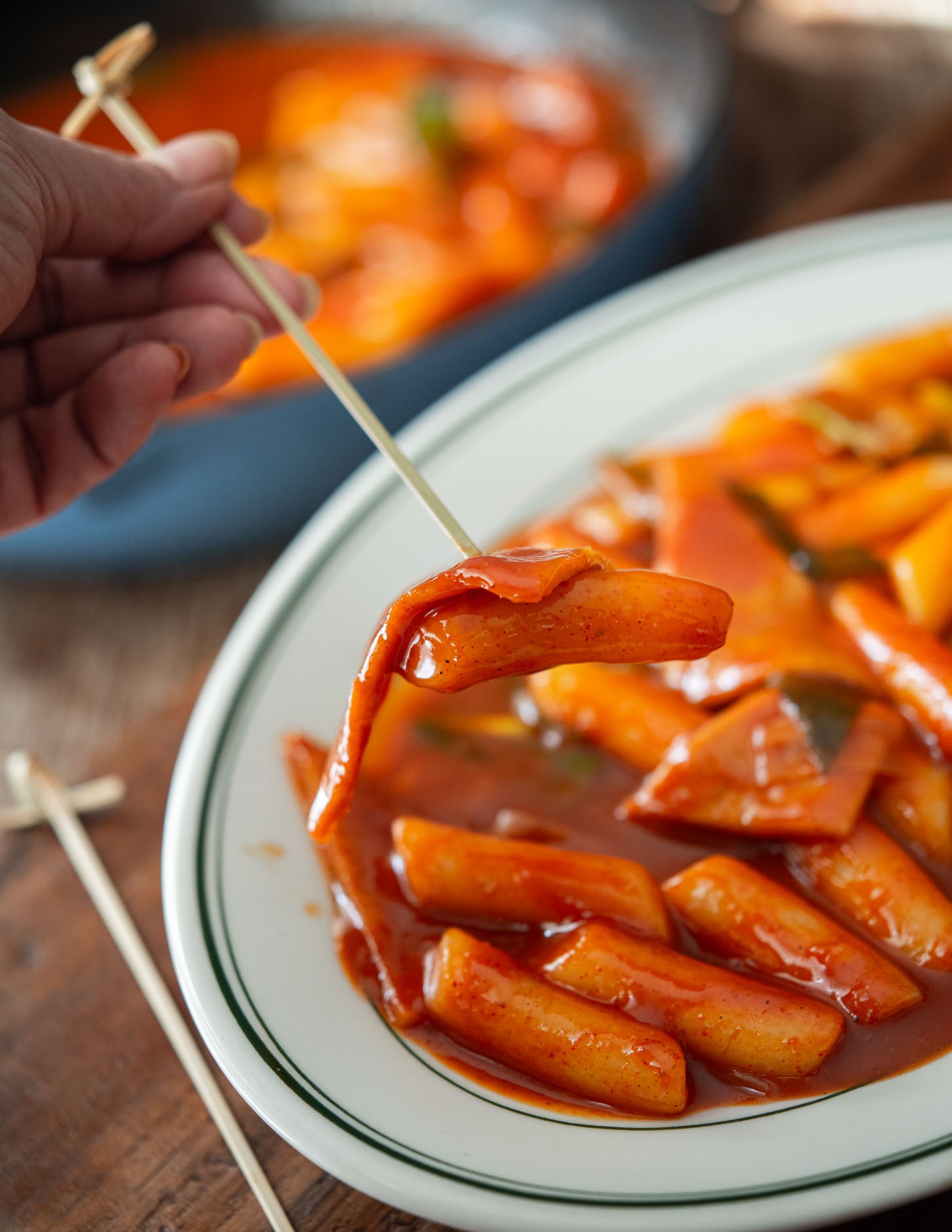

Authentic Tteokbokki (Korean Spicy Rice Cakes)
Recipe Video
Ingredients
- 1 lb (450 g) rice cakes
- 2 sheets fish cake, sliced large bite-size strips
- 1 (about 100 g) Asian leek or 3 green onions, sliced
- 2-1/2 cup (600 ml) water
- 2 anchovy stock coins
- 3 tbsp (45 g) Korean chili paste (gochujang)
- 1 tbsp (7 g) Korean fine chili powder (goun-gochugaru), see note below
- 1 tbsp (15 ml) soy sauce
- 1-1/2 tbsp (20 g) light brown sugar, or more for your preference
- 1-1/2 tsp (4 g) onion powder
- 1 tbsp (15 ml) Korean oligo syrup, optional
Instructions
- If using refrigerated or frozen rice cakes, soak them in warm water for 10 minutes until softened and separated. Drain and set aside.
- In a deep skillet or shallow pot, combine water, Korean stock coins, gochujang, gochugaru, soy sauce, brown sugar, and onion powder. Stir well to dissolve the paste.
- Bring the sauce to a gentle boil, add the rice cakes, and simmer over medium heat for 7–10 minutes, stirring often so they don’t stick. The sauce will begin to thicken as the rice cakes become soft and tender.
- Stir in the fish cakes and leeks. Continue to simmer over medium-low heat for 3–5 minutes until everything is coated and the sauce reaches your desired consistency. For that glossy look, drizzle a little Korean oligo syrup in the last minute of cooking. Serve immediately.
This was my first time making tteokbokki! I didn’t make the anchovy stock (or have fish cakes), so just used dashi instead, but definitely will try to get those for next time. It came together really quickly!!
Wanting to make this in a few days for a birthday celebration, but I don’t think I will ba able to find dried anchovies locally. Can I sub anchovy paste in some way? Thanks!
I am afraid that anchovy paste has lots of sodium in it so it might not be suitable to replace for the dried anchovies.
I found a good replacement in amazon and I think it might work better. It’s a anchovy dashi pack and doesn’t need refrigeration, so it can ship easily.
My kids love rice cakes, and I love spice, so I’m gonna have to make this — but maybe separate it into portions, so that I can have it at full spice level and the boys can have it less spicy! Glad you had an enjoyable trip to Korea! I still need to visit one day!
Travel is really difficult at the moment, so glad you were able to get away. Bet you had fun! Anyway, this is a lovely dish — loads of flavors. Thanks!
Can’t remember when I last had those chewy delicious rice cake. I need to visit Asian store very soon.
You’re hilarious! Funniest recipe I’ve read. Thanks
OMG Your writing style makes these recipes so fun to make! I absolutely love Korean food and I’m glad I could find your blog. Definitely bookmarking this deliciousness. Thanks!
Thank you, Ajuuma.
I NEED immediate HELP! If I bought Korean Rice cake (Garaettok) to make Ttoboki or dak galbi how long can they last outside of the fridge? or should they be kept in the fridge all the time??
Hi, thank you for the recipes 🙂
Could we replace the stock of anchovies and sea kelp with mix of water and chicken powder (the one from Knorr)?
Thank you.
You can just use plain water.
This is one of my fav korean dish! I could never get bored of korean food! Love love love 😉
I visited some friends in Korea this past spring and I am HAUNTED by this dish. I could not get enough of it. I almost got it from every vendor who sold it! There are a few local Korean restaurants where I live in the mdwest and I order this (or a similar stew with rice cakes and ramen) as an appitizer every time. I am going to make this over the weekend. Thanks for sharing your recipe!
Hi love, thanks for your recipe, btw may I ask you why my rice cakes turn our hard and not that chewy after I cooked them? Pls help me:)
Did you use frozen cakes? If using frozen cakes, soak them in water for 10 minutes before adding to the recipe. They tend to get hard faster than fresh kind so they need longer cooking time.
Thank you very much for your reply, holly!! I will soak them Nx time before is cook them.
Hi hi! I love rice cakes!! And I really enjoyed this blog post of yours. You have a very interesting sense of humor! Hehe will definitely try out this recipe soon!!!
Just made this dish; it’s the first Korean dish I’ve ever made and I’m quite thrilled with the results. Awesome, thank you.
I added a few squirts of toasted sesame oil near the end, which was a great addition. It’s my favourite secret ingredient.
I ate this for the first time today after being in Korea for a week. I loved it so much that I ended up here ! I can’t wait to visit my family back in Europe and cook this for them ! They’re going to love it (I just hope they have the ingredients at the asian supermarket). Thanks for the recipe !
Hi, this sounds like a tasty and great recipe, however, I’m studying in the UK in an area where there is two tiny asian markets. I couldn’t find dried anchovies, is there anyway I can substitute or buy a stock which will resemble. I really would like to make my own stock but unfortunately I’m limited at the moment from ingredients.
You can use the dried sea kelp only if you can’t find the anchovies. You can also use powdered form of dried anchovies but make sure it doesn’t have too much sodium in it.
You have a great website! Quick question, your recipe is for the frozen rice cakes, I was able to buy fresh ones, how should I cook them? Should I add them after the sauce has thickened and cook for about ten minutes, or wait until the last minute? Thank you!
If using fresh rice cakes, reduce the amount of stock by 1/2. You don’t need to cook that long as it is written in the recipe. Other than that, you can simply follow the direction.
Hi! I made this dish a couple days ago and the flavor was delicious…but my rice cakes were kind of soggy 🙁 Do you know why? I didn’t make the broth in the first step (i just used stock), so rather than soaking them in the hot broth for 5 minutes, I soaked them in instant hot/boiling water from my tap for 5 minutes. Now I’m confused what water you actually soaked yours in…just regular tap water??
Thanks!
Hi Amy
Is your rice cakes fresh kinds (never been chilled or freezen)? Because you don’t need to soak fresh rice cakes since they are already soft. If your rice cakes are frozen, it might be that your rice cakes are not made of 100% rice. Some rice cakes contains wheat and they can be soggy after a long soaking or braising. Check the ingredients on the package. I soaked mine in regular tap water(hot).
Thank you for your reply! I think maybe the water I soaked it in was too hot! They were frozen, but I”ll have to check if they were pure rice.
HI! I loveeeeee the rice cakes but just need to know how can I store them overnight as i”ve made too much. And will it be good after I’ve reheated them the next day? Thnkas!
Unfortunately leftover rice cakes are not that great in terms of the texture once chilled with sauce in the fridge. You can reheat but they won’t taste the same.
My spicy red cake don’t turn out to have that red colour that you have :'(
Hmmmm, did you try to cook down the sauce? It will eventually thicken and the color will be intensified. Sorry to hear your rice cake was not as red as mine. But I hope you liked the taste, though. That is the most important thing, right? 🙂
Thanks Holly,
I went to Bucheon and Jeju a month ago for my New Zealander son’s wedding to a lovely Korean lady, certainly not Ajumma (and I wouldn’t call anyone anything at all in Korea, having navigated a family home meal with trepidation and still hoping that we weren’t considered barbarians).
We were very much hosted and I didn’t have a chance to strike out alone, so missed Ddukppoki.
I’ve walked past a restaurant in Strathfield, Sydney Australia which advertises DDukbboki and (being a barbarian again) thought that it was just a catchy name. Now I get it. There did seem to be quite a few chic young Korean teens in proximity. so traditions live on despite the Macjunk chain.
Just down the street from the aforesaid I found all the ingredients easily, Strathfield being one of Sydney’s little Koreas. One question: A few weeks ago I bought from Sydney city Chinatown some anchovy soup stock from Korea which is a powder. I also have whole anchovies which I bought to make that fried side dish. Which would be better for Ddukppoki? Or perhaps no difference?
Hi Ross
Thanks for your comment. Ddukbboki is perhaps one of the *must try* street food of Korea. Hope you get to try soon.
To answer your question, the powder form of anchovy stock, some has MSG and some don’t. Check the ingredients in the back. I normally don’t use the powder form of anchovy stock base but if MSG doesn’t bother you, it makes decent stock.
The small dried anchovies for fried side dish, if they are the tiny kinds, they won’t make much flavor to make stock unless you use tons. So I would save them to make side dishes.
If you are planning to make authentic Korean foods often, I would recommend to get some med-large size dried anchovies. Koreans use them often to make soups, stews, kimchi filling etc. You will find that I used them very often in my recipes.
I chuckled a little when you mentioned Barbarians. That is funny description.
Hi Ross,
I was wondering if you remember the grocer you bought the dduk from. I live in Sydney and no matter how many times I go to Korean grocers I can’t seem to find these wonderful rice cakes.
Thanks ^_^
Pardon the delay.
I found the rice cakes in the second Korean shop from the railway station along the Boulevard in Strathfield, passing the restaurant that sells Dukkbokki as a dish.
The more extensively stocked Korean supermarket inside Strathfield Plaza has rice cakes too. Not so long ago this supermarket had fresh jujubes, which might excite our blog host.
The Thai Kee IGA supermarket in Haymarket, Sydney CBD (Level 1 Market City) has them too as well as a limited range of Korean foodstuffs.
All the rice cakes that I have seen in Sydney are made in Australia, they do work so I guess that they are satisfactory.
Another thought:
Very close to the Thai Kee IGA supermarket and on the same level is a liquor shop called “Red Bottle” that always has Soju and other Korean liquors including Bek Se Ju, which I understand (Holly, correct me if necessary) is a way of obtaining a ginseng hit.
The liquor shop in the Boulevard in Strathfield a block or so from the grocery is also well stocked with Korean liquor, in contrast to its ocker days when it was beer, wine and whiskey on the shelves.
Thank you for your blog Every recipe looks wonderful (without meat) I especially love spice-y food. I have only eaten Korean food bought from the store. I am definitely pinning you!
I bought some rice cakes 3 days ago from the Asian shop (I’m in New Zealand). They don’t have an expiry date on them but have gone rock hard in the packaging. I am sure they were softer when I bought them.
Are they still OK to use? How long will they last in the fridge and if I freeze them will they change consistency?
Thanks for your help.
Hi Anne
They are still usable. Soak them in water for a few minutes first before you add to this recipe. The best way to keep rice cakes is freezing them. They can last quite a while, about 3 month in the freezer.
There is an explosion if deep-frying the rice cake. Why does that happen?
It is dangerous to deep fry this type of rice cakes. When oil gets relly hot it will sear the surface of the rice cakes and the cake expands due to the heat. The moisture inside rice cakes will come to the surface of the cake and contact the hot oil. Boom! It will explode! Do not deep fry rice cakes!
I am a white Jewish female and I LOVE, LOVE, LOVE making and eating Korean food! My pantry and refrigerator are filled with Korean products! There are many Asian markets and a huge Korean market close to where I live so making these recipes is really easy.
I am definitely going to make the Spicy Korean Rice Cakes tomorrow!
I’ve eaten the fish cakes, they’re delicious, so I’ll be adding that to this recipe too. That addition should make this recipe really, over the top, delicious.
I can’t wait to eat this!!!!
Thanks so much for this blog.
hi! I am from malaysia, i live in selangor….where can I buy the korean chili paste in selangor?
Hi Munirah2
I don’t know much about Korean stores in Selangor. If you have chance to visit KL, There are many Korean groceries in Ampang and Mont Kiara area.
Thank you for posting this! It helped me a lot.
My parents praised me and my sister cause we cooked this dish well.. :p
I tried to make this dish by myself for my friends and they said it was good ^_^
Thanks so much!
Hi! I’ve tried cooking tteokbokki but its somewhat a fail? It’s too watery. Anyways thanks for this recipe. I will try it again next time with maybe less water. 🙂
It will have some liquid in the beginning stage. You just to have to continue to cook off the liquid over high heat once everything is soft, if you prefer the thicker sauce. Hope you get to give it another try.
Is there a way to make the rice cakes with rice flour? I live in New Zealand and I shop at the most asian supermarket I’ve found in Auckland, and have yet to come across packaged Korean rice cakes or Korean chilli paste :/
Oh. Sorry, nevermind. Just found a recipe for rice cakes 🙂
I was wondering can I use can anchovies in oil? I can’t find dried ones in Miami thx
You can skip the anchovies. I wouldn’t use anchovies in a can.
I here in saudi arabia.i love korea and korean food.i will try to make a home-made rice cake.thanks for the information and God bless you always.bye(@!@)
There are several Korean groceries in Ampang and Mont Kiara. You should be able to find some there.
where can i find the rice cake? am from malaysia and i love korean food ~wink~
do you have any idea where to find it here instead of making the rice cake.
You can use plain water. However stock will bring more flavor to the dish.
do you have to make/use stock?
I found Korean chili paste at many cold storage stores in KL.
Unfortunately there is no substitute for it since it is unique to Korean cuisine.
Hello, I am from Msia. do u have any idea what to replace the korean red chilli paste? This is because I couldnt find it here :(( found ur blog while looking for spicy korean rice cake recipes. hhehe 🙂
totally awesome…its very great since i wanted to learn it…thanks to you..beyondkimchee…nice name huh
@a01ecd788d688bf285d0ef9f78af4bdd Hmmm…, I have to say NO for substituting chili paste with soybean oil for Korean chili paste. They are different. If you are not near Korean market, try ordering online. Amazon carries Korean stuffs and Hmart has their online shop as well.
Hi! First of all, i would like to say thank you for making this blogspot! i absolutely think your dishes look amazing and would like to try these rice cakes as soon as i can, i am not near a korean market and i currently have 'chili paste with soy bean oil' can i substitute this spice for the korean chili paste??
Great dish… I made some substitutions, using chinese xo sauce instead of anchovies, etc… still turned out delicious anyway!
Hi there,
You can use chicken stock but it will bring slightly different flavor. Use low sodium chicken stock since the chili paste already has some sodium in it. Also you can use the flat rice cake slices as well. But reduce the amount of liquid into 1/2. The will get cooked faster.
I Loved your blog. Not only the dishes looks inviting but very entertaining too. I've been dying for rice cake since last week. Went to H-Mart in Irvine while visiting my daughter at UCI and was looking forward to buy the spicy fried dubokki but they were out of it at the ready cooked section. Ended up buying the rice ovalette and gochujang sauce but not sure how to cook them until I saw your blog. I am going to try to cook them today. Your recipe uses the long rice cake, is there any difference from using the oval type rice cake? Before your blog I found an Ahjushi's blog but he didn't use enchovies and kelp but instead uses chicken stock.
I like the symbols you have on the site. What are they called? Would like to decorate my walls with them.
Hi
Hmmm, I'm sorry to hear that it was watery. It should be somewhat saucy but not watery though. I wonder it there was too much stock/water. Reduce the amount of liquid a little and cook up the liquid over higher heat, UNCOVERED. The sauce should eventually thickens and be able to coat the rice cakes over all. Hope this helps. Please let me know how it turns out next time.
Hi, I just made this dish now but found that it was too watery. I think maybe I put too much water in the pan. Love your blog.
I am glad I came upon this recipe, very authentic… how my Mom makes it too! I like your style of presenting this recipe. You are funny and creative 🙂
Hi Cynthia
Yes, you can change to chicken stock, but use low sodium one. You might want to reduce the chili passte just a little since most store bought chicken stocks have lots of sodium in them.
lol, can I change the fish cakes and stock for chicken, because I'm allergic to sea food.
I just found your blog and love it! I lived in Korea for a year and half and miss Korean food. I laughed outloud at your description of an Ajumma…you described them perfectly!! I plan on using your tutorials to make some of that yummy goodness 🙂
@9b40a37369b581ac3f92fab250c69c25
You can double the recipe but reduce the amount of the stock and the chili paste a little bit first (by 1 1/2X instead of 2X). You can always add more if you need.
You don't need to add kelp. Anchovies alone can bring wonderful flavor.
Have fun making them and let me know how it turned out.
Thank you so much for posting this I can't wait to try making it ^-^
If I were to make a bigger batch, say for about 8 people, I just have to double everything, right? Including the amount of anchovies for the stock? And also, can I skip the sea kelp and just have the anchovies?
Yes, you can use water instead of anchovy stock. But DO NOT add the fish
sauce, it will make the dish very very salty.
Can I use some water and fish sauce instead of making the anchovie stock?
thank you so much 🙂
Thanks! Everybody loves rice cakes. It is spicy but so good!
Sure, you can use just plain water, vegetable or chicken stock. It will taste slightly different but still good. You can skip the fish cake. I sometimes add dry ramen noodles or sweet potato noodles (the Japchae noodle). It will be a carb explosion! 🙂
how would you incorporate the ramen noodles instead of the fish cakes?
Add the ramen noodle when you add the rice cakes and cook them together.
Hello i wanted to know,is there another way to make this without using fish cakes and dried anchovies,i dont eat any type of seafood,but always wanted to try rice cakes 🙂
This is what I always eat when we went to Korea! It is really delicious especially the spicy one! Koreans have this really nice taste when it comes to sauces.
Hi Holly,
Thanks for your fast help! Actually I had the same frozen ones as shown in your picture. But when I soak them they crack up. I also made tteok myself (poor attempt) and froze them for later and I have the same problem with them. Maybe some kind of storage problem? Or it depends on the temperature of the water?. Do you let them defrost slowly before you soak them?
I will experiment some more tonight for dinner! 🙂
oh I always love the redness in Korean dishes. So appetizing! Thanks for sharing this great recipe! About the rice cake, is it the same with mochi?
I love all types of Korean food! This looks so good! I'm glad that I found your blog!
Does the cooked rice cakes keep well overnight in fridge? If reheated will the texture change?
You might want to add a tablespoon or two of water and cover with cellophane before microwaving. This will help rehydrate the rice cakes.
Hi! Thanks for posting the recipe. I just left our local Asian market with a bag of refrigerated rice cakes and had not the slightest clue of how to go about cooking them. I'm heading out to the grocery store now to pick up the rest of the ingredients for your 'Spicy Korean Rice Cakes.' 🙂
@Laura
Hi Laura
I would love to hear how you and your boyfriend like it. Thanks for visiting my blog.
Thank you so much for posting this recipe! My Dad lived in Korea and when I went to visit him this was my absolute favorite dish. Now I can't wait to get the ingredients together and make it for my boyfriend.
I can't wait to try making this tasty-looking dish!!
Hi Eunice and eating vancouver
Thanks for visiting my blog. Hope your Ddukppoki turned out good.
I'm bookmarking this recipe: thanks!
While I didn't grow up in Korea, I definitely grew up in a household where ddukppoki was a staple. Now, whenever I go home to visit the family, my mom makes me be the one to prepare and make this dish! Mmmm, I may have to go buy some dduk tonight and make it tomorrow!